 FishKillFlea
As of late 2025, Florida FWC eliminated online and phone sales of 3-day and 7-day non-resident fishing licenses. These short-term licenses must now be purchased IN PERSON ONLY at authorized retailers including Walmart, Bass Pro Shops, Tax Collector offices, and local bait shops. Annual non-resident licenses ($47) remain available online at GoOutdoorsFlorida.com. Plan ahead — you cannot buy short-term licenses at the airport or marina dock anymore.
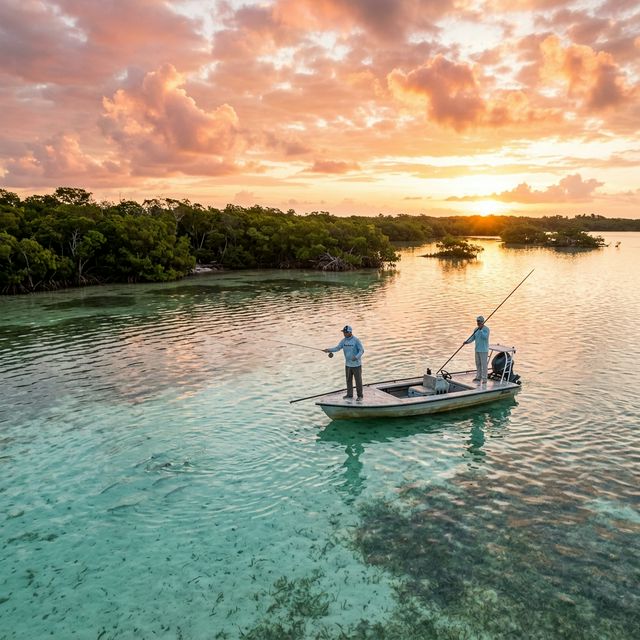
You’re sitting on the tarmac at Fort Lauderdale-Hollywood International, your rod tube jammed into the overhead bin, scrolling through FWC’s website while the flight attendant asks everyone to put their phones away. Your buddy in Islamorada texted you the tide chart — incoming tide on the oceanside flats starting at 7 AM tomorrow. Permit are tailing. But here’s the detail that trips up thousands of visiting anglers every year: Florida doesn’t sell a single “fishing license” that covers everything. The state splits freshwater and saltwater into separate licenses, and if your trip touches both — say, a morning on Lake Okeechobee and an afternoon in the Keys — you need two licenses. At $47 each, that’s $94 before you’ve even tied on a fly.
Florida is the most-visited fishing destination in the United States: 2.8 million resident anglers and roughly 3.2 million non-resident fishing trips each year. The Florida Fish and Wildlife Conservation Commission (FWC) manages a licensing system that’s both flexible and full of traps for out-of-state visitors — from the $10 Snook Permit requirement that most first-timers don’t know about, to pier exemptions that can save you $47 entirely, to a charter boat loophole that eliminates the license requirement altogether.
Non-Resident License Types and Costs
Florida structures its recreational fishing licenses by water type (freshwater or saltwater) and duration (annual, 7-day, or 3-day). Unlike Texas or California, there is no “combo” or “all-water” license — you must buy each separately if you plan to fish both environments.
| License Type | Duration | Price | Purchase Method |
|---|---|---|---|
| NR Annual Freshwater | 12 months | $47.00 | Online, phone, or in person |
| NR Annual Saltwater | 12 months | $47.00 | Online, phone, or in person |
| NR 7-Day Freshwater | 7 consecutive days | $30.00 | IN PERSON ONLY (as of late 2025) |
| NR 7-Day Saltwater | 7 consecutive days | $30.00 | IN PERSON ONLY (as of late 2025) |
| NR 3-Day Freshwater | 3 consecutive days | $17.00 | IN PERSON ONLY (as of late 2025) |
| NR 3-Day Saltwater | 3 consecutive days | $17.00 | IN PERSON ONLY (as of late 2025) |
Source: FWC Recreational Fishing License Fees, verified March 2026.
2026 Purchase Restriction: What Changed
In late 2025, FWC discontinued online and phone sales of all non-resident 3-day and 7-day licenses. This policy change affects thousands of visiting anglers who previously purchased short-term licenses through GoOutdoorsFlorida.com or by calling 1-888-FISH-FLORIDA.
Where to buy short-term non-resident licenses now:
- Walmart stores (sporting goods section)
- Bass Pro Shops and Cabela’s
- County Tax Collector offices
- Local bait and tackle shops
- Marina pro shops
What’s still available online:
- Annual non-resident licenses ($47 freshwater or saltwater)
- All resident licenses
- Permits and stamps (Snook, Lobster, etc.)
Planning tip: If you’re visiting Florida for a week or less, either buy your short-term license at a retailer near your destination, or consider purchasing the $47 annual license online before your trip. The annual license is only $17 more than a 7-day license and eliminates the in-person purchase requirement.
The Break-Even Math
The annual license ($47) breaks even against short-term options faster than you’d expect:
- 3-day license at $17: If you fish two separate 3-day trips within 12 months ($17 × 2 = $34), the annual isn’t justified yet. At three trips ($17 × 3 = $51), the annual saves money.
- 7-day license at $30: A single 7-day trip costs $30. A second trip within the year costs $60 total — the $47 annual saves $13.
- Mixed scenario: If you visit Florida for a 7-day trip and then return for a 3-day trip, buying both short-term licenses costs $47 — identical to the annual. Add one more day, and the annual wins.
The real trap: Many visiting anglers fish both freshwater and saltwater during a single Florida trip. If your itinerary includes Lake Okeechobee bass fishing AND Keys flats fishing, you need both licenses. Two annuals ($94) vs. two 3-day licenses ($34) — run the math based on your actual trip length.
Florida’s Add-On Permits: What Stacks on Top
Unlike most states where the fishing license is all you need, Florida requires additional species-specific permits for certain high-value game fish. Missing one of these is the single most common FWC citation for non-residents.
Snook Permit — $10/year
Required for: Any angler who catches, attempts to catch, or harvests snook in Florida waters. This applies even if you’re practicing strict catch-and-release.
Snook are Florida’s premier inshore game fish — explosive strikes, drag-screaming runs, and strict slot limits (28–33 inches on the Atlantic coast, 28–33 inches on the Gulf). The $10 Snook Permit is required in addition to your saltwater fishing license. Non-residents are not eligible for the 5-year permit ($50) — that’s residents only.
Tarpon Tag — $51.50/year
Required for: Any angler who intends to keep a tarpon. Since tarpon are almost exclusively catch-and-release (you need an IGFA record application to legally keep one), most visiting anglers don’t need this tag. But if you’re chasing a world record in Boca Grande Pass, the tag is mandatory.
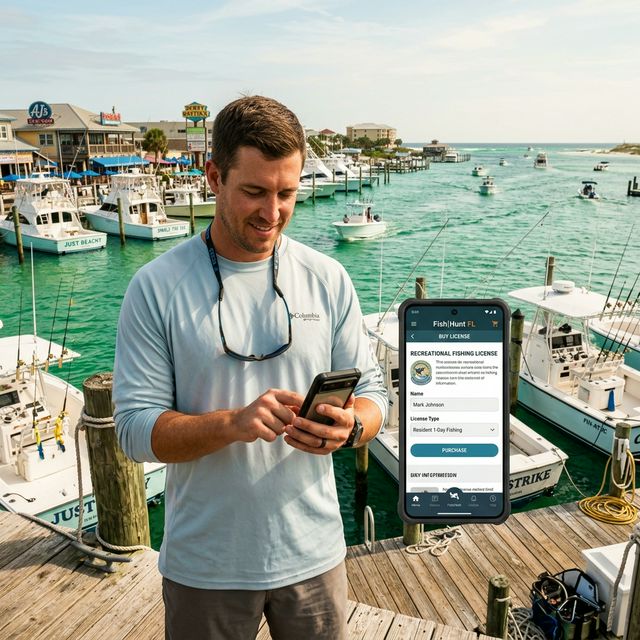
Purchase restriction: Tarpon tags are only available at County Tax Collector offices — you cannot buy them online, through the Fish|Hunt FL app, or at tackle shops. Plan ahead if you’re traveling specifically for a record attempt.
Spiny Lobster Permit — $5.00
Required for: Taking or attempting to take spiny lobster during Florida’s recreational lobster season. The two-day “mini season” falls on the last consecutive Wednesday and Thursday of July each year (July 30–31 in 2025). The regular sport season runs August 6 through March 31. Required in addition to your saltwater license.
Shore-Based Shark Fishing Permit — Free
Required for: Any angler 16 or older fishing for sharks from shore, bridges, jetties, or piers. You must complete a free online education course through FWC before receiving this no-cost permit.
State Reef Fish Angler Designation — Free
Required for: Any angler 16 or older who fishes for or harvests certain reef fish species from a private recreational vessel in Florida. This designation is free but must be renewed annually.
This is one of the most overlooked requirements for visiting anglers — particularly those who book bottom fishing trips on private boats (not charters). The designation applies to 13 species:
- Red snapper, vermilion snapper, mutton snapper, yellowtail snapper
- Gag grouper, red grouper, black grouper
- Greater amberjack, lesser amberjack, almaco jack, banded rudderfish
- Hogfish, gray triggerfish
Critical distinction: If you fish from a licensed charter vessel, the captain’s license covers the reef fish reporting. But if you fish from a friend’s boat or your own rental boat, you personally need this free designation. Even seniors (65+) who are exempt from the base fishing license must have this designation.
Obtain it at GoOutdoorsFlorida.com, the Fish|Hunt FL app, by phone, or at any license agent.

Piscifun Fishing Tackle Backpack
Large capacity fishing backpack with tackle boxes. Waterproof rain cover included.
Affiliate link · Prices may vary
How to Buy: Four Purchase Channels
1. GoOutdoorsFlorida.com (Annual Licenses Only)
The official FWC online portal. Available 24/7 for annual non-resident licenses only ($47 freshwater or saltwater). You’ll need a valid government-issued ID (driver’s license or passport) and a credit or debit card. Your license is available immediately as a digital download. Online handling fee: $2.25 plus a 2.95% surcharge on the total sale.
⚠️ Important: As of late 2025, 3-day and 7-day non-resident licenses are NOT available through the online portal. You must purchase these in person.
2. Fish|Hunt FL Mobile App (Annual Licenses Only)
Download the free app (iOS and Android). Purchase, store, and display annual licenses directly from your phone. The app works offline after the initial download — critical when fishing the Everglades backcountry or remote Ten Thousand Islands where cell coverage is nonexistent. Same online fees apply.
⚠️ Important: Short-term (3-day and 7-day) non-resident licenses are NOT available through the mobile app as of late 2025.
3. By Phone (Annual Licenses Only)
Call 888-FISH-FLORIDA (888-347-4356). Phone handling fee is higher: $6.25 plus a 2.95% surcharge per person. ⚠️ Important: As of late 2025, 3-day and 7-day non-resident licenses are NOT available by phone. Only annual licenses can be purchased via phone.
4. In-Person Retail Locations (Required for Short-Term Licenses)
For 3-day and 7-day non-resident licenses, in-person purchase is now mandatory as of late 2025. Authorized retailers include:
- County Tax Collector offices — Most reliable option, available in every county
- Local bait and tackle shops — Many are authorized FWC license agents
- Bass Pro Shops and Cabela’s — All Florida locations sell short-term licenses
- Walmart — Sporting goods section (availability varies by location)
- Marina pro shops — Especially in popular fishing destinations
What you’ll need: Valid government-issued photo ID (driver’s license or passport) and payment method (cash or card accepted at most locations).
Planning tip for visitors: If you’re flying into Florida for a short fishing trip, locate a Tax Collector office or tackle shop near your destination before you arrive. Many tackle shops near popular fishing areas (Keys, Destin, Tampa Bay) are accustomed to selling licenses to tourists and can process your purchase quickly.
The Pier and Charter Exemptions: How to Fish Florida Without a License
Florida offers two significant license exemptions that can save non-residents real money:
Licensed Pier Exemption
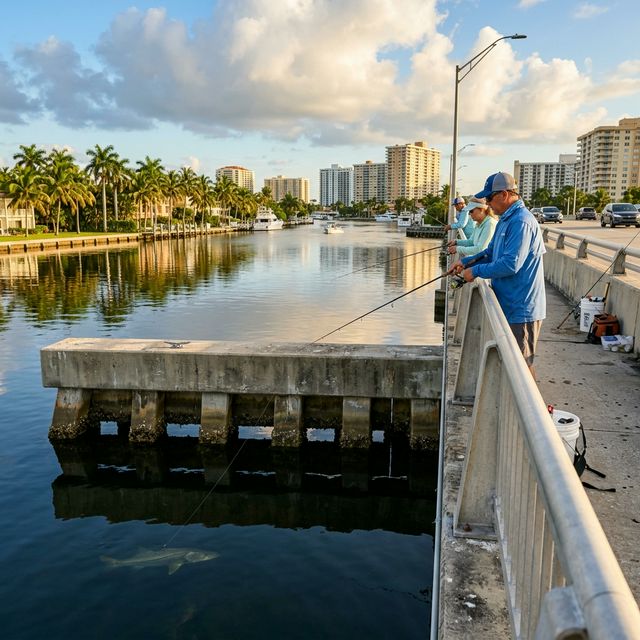
If a fishing pier or bridge holds a valid saltwater pier license issued by FWC, everyone fishing from that structure is covered — no individual saltwater license required. Major piers that typically hold this license include:
- Sunshine Skyway Fishing Pier (Tampa Bay)
- Juno Beach Pier (Palm Beach County)
- Sebastian Inlet State Park Pier (Brevard County)
- Navarre Beach Fishing Pier (Santa Rosa County)
- Pensacola Beach Gulf Pier (Escambia County)
Important: Not all piers have a pier license. Always ask before assuming you’re covered. And even on licensed piers, you must still follow all bag limits, size limits, seasonal closures, and species-specific permit requirements (like the Snook Permit).
Licensed Charter Vessel Exemption
If you’re fishing from a for-hire charter or guide boat that holds a valid FWC charter license, you do not need your own individual fishing license. This exemption applies to both freshwater and saltwater charters. The captain’s license covers everyone on the vessel.
This is a significant cost-saver for families: a group of four fishing a Keys charter for one day avoids $68 ($17 × 4 for 3-day licenses) or more — savings that often offset the charter booking cost.
The catch: If you step off the charter boat and fish from the dock, the exemption ends. You need your own license the moment you leave the licensed vessel.

Plano Guide Series Rod Tube Case
Hard-shell rod tube protects rods during travel. Airline-approved for checked baggage.
As an Amazon Associate, we earn from qualifying purchases. Prices may vary.
No Reciprocal Agreements: Florida Stands Alone
Unlike Texas (which has a Louisiana border water agreement) or California (which shares Colorado River and Lake Tahoe reciprocity with neighboring states), Florida has zero reciprocal fishing agreements with any state.
- A Georgia license does not work on the St. Marys River, even on shared border waters
- An Alabama license does not work on Perdido Bay, even on waters that touch the state line
- A valid license from any other state provides zero coverage in Florida
For anglers driving through multiple Gulf Coast states: Budget a separate Florida license for every day you fish Florida waters. The $17 three-day license is your most cost-effective tool for brief stops.
Cost Comparison: Florida vs. Gulf Coast Neighbors
| State | NR Annual | Short-Term NR Option | Fresh + Salt Separate? | Source |
|---|---|---|---|---|
| Florida | $47 × 2 = $94 | $17 (3-day), $30 (7-day) | ✅ Separate licenses | myfwc.com |
| Alabama | $66.25 (FW only, non-LA/MS) | $37.00 (7-day trip) | ❌ Combined | outdooralabama.com |
| Texas | $68 (all-water) | $16 (1-day) | ❌ Combined | tpwd.texas.gov |
| Louisiana | ~$60 | $5 (1-day), $15 (3-day) | ❌ Combined | wlf.louisiana.gov |
| Georgia | ~$65 | $3.50 (1-day) | ❌ Combined | georgiawildlife.com |
Florida’s split system means non-residents who fish both environments pay the most in the region — but the 3-day option ($17) is one of the cheapest short-term licenses on the Gulf Coast. For a quick weekend trip focused on one water type, Florida is surprisingly affordable.
Alabama note: Alabama’s NR pricing changed significantly — their annual freshwater license now runs $66.25 for anglers from states other than Louisiana and Mississippi (which have reciprocal pricing agreements with Alabama). Their 7-day trip license jumped to $37.00. This makes Florida’s $47 annual per water type genuinely competitive for single-environment fishing.

KastKing Blackhawk II Telescoping Rod
Portable telescoping design collapses to 17 inches. Perfect for travel fishing.
Affiliate link · Prices may vary
What Happens If You Get Caught Without a License
Fishing without a valid license in Florida is a second-degree misdemeanor under Florida Statute 379.354. FWC law enforcement officers are fully commissioned and can stop you on the water, at boat ramps, on bridges, and along shorelines.
Penalties include:
- Fines up to $500 per violation
- Up to 60 days in jail (rarely applied for first offenses, but legally authorized)
- Forfeiture of fishing equipment used during the violation
- Civil penalties for fisheries violations (such as undersized or over-bag-limit fish)
- Repeat offenders face enhanced penalties and potential felony charges
FWC also operates a Wildlife Alert Hotline (888-404-3922) where the public can report suspected violations — and they do. Crowded piers, popular boat ramps, and tournaments are high-enforcement zones.
Planning a Multi-State Gulf Coast Trip
The classic “Gulf Coast Crawl” — Louisiana marshes to Alabama’s Gulf Shores to Florida’s Panhandle — crosses three states in a single driving day. Here’s the most cost-effective licensing strategy:
- Louisiana: Buy a 1-day charter license ($5) for marsh fishing
- Alabama: Buy a 7-day all-water trip license ($21.35) for Gulf Shores and Mobile Bay
- Florida Panhandle: Buy a 3-day saltwater license ($17) for Destin and Pensacola
Total for a 7-day Gulf Coast road trip fishing three states: approximately $43.35 — less than a single Florida annual saltwater license. Mix and match short-term licenses based on actual fishing days in each state.
For freshwater anglers planning a bass fishing circuit (Toledo Bend in Louisiana → Lake Eufaula on the Georgia-Alabama border → Lake Okeechobee in Florida), remember that Florida requires a separate freshwater license — the $17 three-day option is your best tool for a quick Okeechobee stop.