 FishKillFlea
Your eight-year-old has been asking to go fishing since she saw a kid reel in a catfish on YouTube. You’re at a Publix in Gainesville buying worms and wondering: do I need to buy her a license? Can she use her own rod? Does her fish count against my limit? And if she hooks a snook off Grandma’s dock in Sarasota next month, does she need that $10 permit?
Here’s the short answer: No license needed. Florida exempts everyone under 16 from fishing license requirements — completely, for both residents and non-residents, in freshwater and saltwater, every day of the year. Your daughter can pick up a rod today and fish any public water in the Sunshine State without a single piece of paperwork. But the rules she has to follow while holding that rod? Those are exactly the same as yours.
The Under-16 Exemption: How It Works
Florida Statute 379.354 exempts all persons under the age of 16 from fishing license requirements.
What the Exemption Covers
- ✅ Freshwater fishing — all lakes, rivers, canals, ponds
- ✅ Saltwater fishing — all coastal waters, bays, Gulf, Atlantic
- ✅ Fishing from any location — shore, boat, pier, dock, bridge, kayak
- ✅ Both resident and non-resident children
- ✅ Year-round — no restricted days or seasons
- ✅ No paperwork, registration, or application required
What the Exemption Does NOT Cover
- ❌ Fishing regulations — bag limits, size limits, and seasonal closures still apply
- ❌ The right to fish on private property without permission
- ❌ Adult accompaniment — children can fish alone, but regulations are their (or their parent’s) responsibility
- ❌ State Reef Fish Angler designation — while children under 16 don’t need a license, the accompanying parent/adult MUST have the free SRFA designation if targeting any of the 13 reef species from a private boat
Age Verification
Florida does not require children to carry proof of age. However, it’s a practical recommendation: if an FWC officer encounters a teenager who appears to be near the 16-year cutoff, having a school ID, birth certificate, or even a parent’s verbal confirmation on-site prevents unnecessary complications.
The Bag Limit Question: Whose Fish Is It?
This is the most common question parents ask — and the most commonly misunderstood rule.
In Florida, each person has their own individual bag limit, regardless of age or license status.
What This Means in Practice
| Scenario | Legal? |
|---|---|
| Your 10-year-old catches 3 bass, you catch 5 bass | ✅ Both within individual limits |
| Your 10-year-old catches 6 bass (limit is 5) | ❌ Over their individual limit |
| You catch 4 bass, give 2 to your child’s stringer | ❌ Misrepresenting who caught the fish |
| You and your child each catch 5 bass on the same boat (10 total) | ✅ Legal if each person’s catch is identifiable |
The stringer problem: When fishing from a boat with children, keep catches separate or clearly identifiable. FWC officers can ask who caught which fish, and combining catches on a single stringer creates ambiguity that can lead to citations.
Pro tip: Give each child their own small cooler or bucket. Label it with their first name in marker. This makes it immediately clear to any inspecting officer that the catches are separated by person.

Thkfish Fishing Accessories Kit
Complete terminal tackle kit with hooks, sinkers, swivels, and bobbers. Everything in one box.
Affiliate link · Prices may vary
Age-Based License Requirements: The Complete Chart
| Age | License Required? | Cost | Notes |
|---|---|---|---|
| Under 16 | ❌ No | Free | Both resident and non-resident exempt |
| 16+ Florida resident | ✅ Yes | $17/year FW, $17/year SW | Or free shoreline license |
| 16+ Non-resident | ✅ Yes | $47/year FW, $47/year SW | Short-term: $17 (3-day), $30 (7-day) |
| 65+ Florida resident | ❌ No | Free | Carry FL driver’s license as proof |
| Any age on licensed pier | ❌ No | Free | Pier must hold FWC pier license |
| Any age on licensed charter | ❌ No | Free | Charter must hold FWC charter license |
The 16th Birthday Transition
On their 16th birthday, a child’s exemption ends. They need a valid fishing license from that day forward. There is no grace period.
Planning ahead: If your child’s 16th birthday falls during a planned fishing trip, buy their license before the trip starts. A resident annual freshwater ($17) or saltwater ($17) license purchased on their 16th birthday is valid for 12 months.
Youth License Options (Optional, Not Required)
FWC offers optional youth licenses that support conservation and provide fishing education:
Resident Youth Saltwater Fishing License
- Eligible ages: 8–15 (Florida residents only)
- Cost: Minimal fee
- Valid until: The child’s 17th birthday
- What it includes: Saltwater fishing authorization with FWC conservation support
Resident Youth Gold Sportsman’s License
- Eligible ages: 8–15 (Florida residents only)
- Cost: Varies
- Valid until: The child’s 17th birthday
- What it includes: Freshwater, saltwater, hunting, plus all standard permits
These are not required — children under 16 fish for free regardless. But they’re a way for families to contribute to conservation, introduce children to the concept of fishing licenses, and receive educational materials from FWC.

Zebco 33 Spincast Combo
Classic push-button reel. No tangles, no backlash — ideal for seniors and beginners.
As an Amazon Associate, we earn from qualifying purchases. Prices may vary.
Free Fishing Days: The Whole Family Fishes Free
FWC designates multiple License-Free Fishing Days each year when all anglers — including adults, non-residents, and those who normally need a license — can fish Florida waters without a license.
Typical Free Fishing Days
FWC announces specific dates annually on MyFWC.com.
2026 confirmed dates:
- Freshwater: April 4–5 (Sat–Sun) and June 13–14 (Sat–Sun)
- Saltwater: June 6–7 (Sat–Sun), September 5 (Sat), and November 28 (Sat — Thanksgiving weekend)
That’s 8 total license-free days (4 freshwater + 4 saltwater) spread across the year, strategically placed on weekends and holidays for maximum family participation.
What Free Fishing Days Do NOT Exempt
- ❌ Bag limits, size limits, and seasonal closures — all still apply
- ❌ Species-specific permits (Snook, Lobster, Tarpon, Shark) — still required
- ❌ The State Reef Fish Angler designation — still required for reef fish from private boats
- ❌ Gear restrictions — still in effect
- ❌ Private property rules — still need permission
Free Fishing Days are specifically designed to introduce new anglers — including families with children — to fishing with the lowest possible barrier to entry.
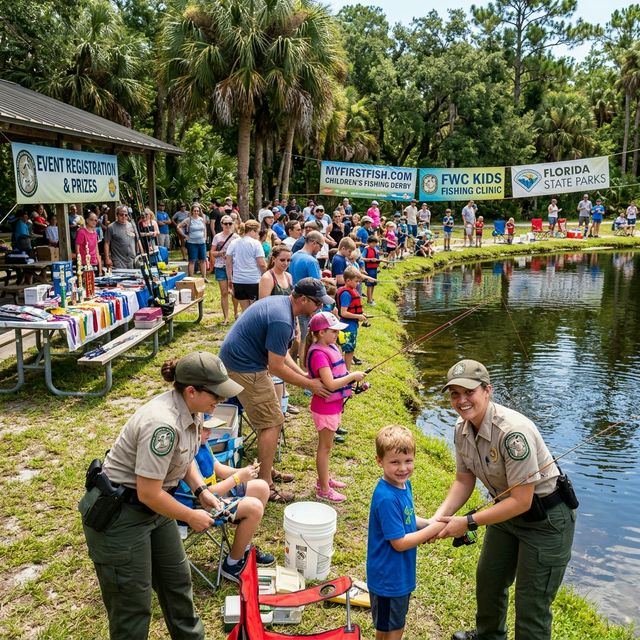
Kids Fishing Events in Florida
Florida runs one of the most extensive youth fishing programs in the country through FWC and its partners:
FWC Kids Fishing Clinics
Free, family-friendly events held at state parks and FWC facilities statewide. Children learn:
- Casting technique
- Knot tying
- Fish identification
- Catch-and-release handling
- Basic fishing safety
All equipment is provided — rods, reels, bait, and tackle. No registration required for most events. Schedule posted at MyFWC.com.
Get Outdoors Florida Day
An annual statewide event with fishing clinics, wildlife demonstrations, and outdoor activities at dozens of locations. Free entry, free equipment, and usually coincides with a License-Free Fishing Day.
TrophyCatch Youth Program
FWC’s TrophyCatch program includes a youth component where children who catch, document, and release trophy largemouth bass (8+ pounds) can earn conservation awards and prizes through the TrophyCatch app.
County and Municipal Youth Derbies
Many Florida counties and cities host local fishing derbies for children. These are typically free, held at local parks and stocked ponds, and include prizes for biggest fish, most fish caught, and youngest angler. Check your county Parks and Recreation department for local events.

Eagle Claw Snelled Hook Assortment
Pre-tied hooks ready to use. Great for live bait fishing.
Affiliate link · Prices may vary
Best Locations for Kids Fishing in Florida
Freshwater (Calm, Easy Access, High Catch Rates)
Lake Alice — Gainesville: University of Florida campus lake with a fishing pier. Bluegill, bass, and catfish are abundant and eager to bite. Paved access, shaded areas, and restrooms.
Lake Eola Park — Orlando: Downtown Orlando’s iconic lake. Stocked with largemouth bass and catfish. Paved sidewalks, restrooms, and nearby restaurants for when the kids get hungry.
Rotary Park — Cape Coral: Freshwater ponds stocked for youth fishing. ADA-accessible, covered picnic areas, and short walks to the water. Peacock bass in nearby canals.
Saltwater (Protected, Shallow, Family-Friendly)
Lovers Key State Park — Lee County: Calm backwater areas perfect for kids to wade-fish for snook and mangrove snapper. Sandy beach, picnic areas, and a nature center.
Fort DeSoto Park — Pinellas County: Protected bay fishing with calm water, sandy bottom, and consistent catches of sheepshead, snook, and spotted seatrout. ADA-accessible fishing piers.
Sebastian Inlet State Park — Brevard County: Structured fishing catwalks overlooking the inlet. Kids can watch fish cruise past in the clear water before casting. Restrooms and bait shop on-site.
Teaching Kids to Fish Responsibly
FWC emphasizes conservation education for young anglers. When fishing with children:
- Teach catch-and-release first — let them experience the catch before focusing on harvest
- Explain size limits visually — carry a measuring tape and show them what “too small” looks like
- Practice proper fish handling — wet hands before handling, minimize air time, support the body
- Use barbless hooks — easier to release fish and safer for little fingers
- Start with panfish — bluegill and sunfish are plentiful, aggressive, and perfect for beginners
- Bring snacks — the fastest way to end a kids’ fishing trip isn’t a lack of bites, it’s hungry kids