 FishKillFlea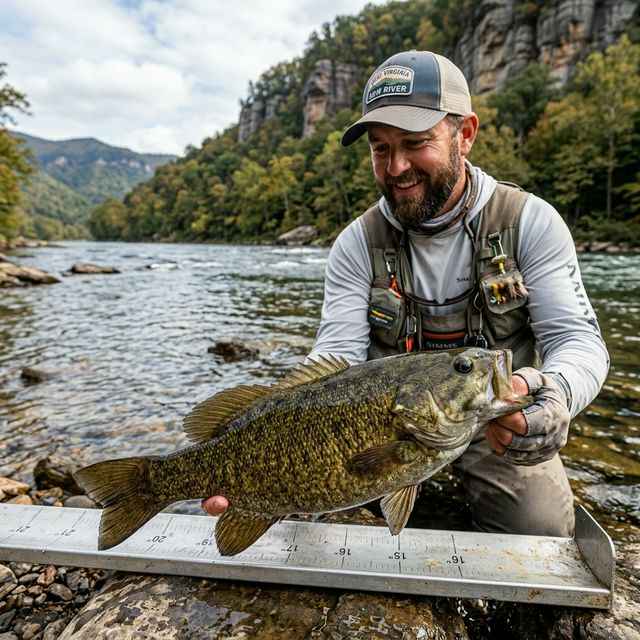
You pull a smallmouth bass over the gunwale of your drift boat on the New River and it looks right — solid, thick, the kind of 16-incher that would be a keeper on most rivers back home. You reach for the measuring board. Sixteen and a half inches. And that’s when the New River’s slot limit catches you: any bass between 14 and 22 inches goes back. This fish, which qualifies as a trophy on most eastern rivers, is a protected juvenile on the New River. You’ll slide it back into the current and thank the regulation for building the fishery you came here to experience in the first place.
West Virginia’s fishing regulations reflect a state that takes its wild rivers seriously. The Mountain State manages 20,000 miles of fishable streams, over 100 public fishing lakes, and the entire length of the Ohio River’s eastern bank — each with species-specific rules that range from the remarkably simple (6-fish general bass limit statewide) to the hyper-specific (catch-and-release sections measured in tenths of a mile). The key to fishing legally here isn’t memorizing every regulation — it’s knowing which waters have special management designations that override the general rules.
Black Bass Regulations (Smallmouth, Largemouth, Spotted)
General Statewide Rules
| Rule | Limit |
|---|---|
| Daily creel limit | 6 bass (aggregate, all species combined) |
| Possession limit | 12 |
| Minimum size limit | None (statewide general) |
| Season | Year-round (except specific closures below) |
Season closure alert: The North Branch of the Potomac River and the Potomac River between Maryland and West Virginia are closed to bass fishing from March 1 through June 15 each year. This closure protects spawning bass during the critical nesting period. All other WV waters are open year-round for bass.
Slot Limit Waters — Where Size Matters
These are the most regulation-dense waters in West Virginia. Pay close attention — citations for bass slot violations are among the most common enforcement actions.
| Water | Slot Range | Daily Limit | Trophy Rule | Notes |
|---|---|---|---|---|
| New River (Gauley confluence to VA line, excl. Bluestone Lake) | 14–22 inches (release) | 6 | Only 1 over 22” | Premier smallmouth fishery |
| Ohio River (entire WV border) | 14–22 inches (release) | 6 | Only 1 over 22” | Reciprocal with Ohio |
| Greenbrier River (6-mile section, US 60 to US 219) | 12–20 inches (release) | 6 | Only 1 over 20” | Outstanding smallmouth water |
| East Lynn Lake | 12–16 inches (release) | 6 | Standard | Quality bass management |
Critical note about the Ohio River: Many anglers know about the New River’s slot limit, but fail to realize the same 14-to-22-inch slot applies to the entire Ohio River under the reciprocal agreement with Ohio. This includes all embayments. Every bass between 14 and 22 inches must be released immediately, and only 1 bass over 22 inches may be retained per day.
Minimum Size Waters — 12-Inch Rule
Several lakes and streams require all bass under 12 inches to be released. The daily creel limit remains 6, but only 1 bass over 16 inches may be kept:
| Water | County |
|---|---|
| Barboursville Lake | Cabell |
| Beech Fork Lake | Wayne |
| Chief Logan Lake | Logan |
| Conaway Run Lake | Tyler |
| South Mill Creek | Grant |
| Wheeling Creek | Ohio/Marshall |
Stonewall Jackson Lake — Trophy Management
Stonewall Jackson Lake uses a unique regulation: daily creel limit of 1 black bass 18 inches or longer. Bass under 18 inches may be harvested within the general 6-fish daily limit. This trophy management approach has produced one of the most consistent big-bass fisheries in West Virginia.
Jennings Randolph Lake — Reduced Limit
This lake on the Maryland border has a reduced 5-bass daily limit (aggregate), with a possession limit of 10. Anglers should also consult Maryland fishing regulations, as the lake straddles both states.
Catch-and-Release Bass Waters (Creel Limit = 0)
No bass may be in the angler’s possession while fishing these waters:
Lakes: Dunkard Fork, Edwards Run Pond, Kimsey Run, Millers Fork Pond, Rockhouse, Tuckahoe, Upper Mud
Streams:
- New River (12-mile section): Fayette, Raleigh, and Summers counties — from the I-64 bridge at Sandstone downstream to the NPS Grandview Sandbar access site near Quinnimont
- South Branch of Potomac (Area 1): 8 miles in Hardy County — Routes 28/55/220 bridge (Petersburg Gap) downstream to County Route 13 bridge (Fisher)
- South Branch of Potomac (Area 2): 9.5 miles in Hampshire County — Routes 28/50 bridge (Romney) downstream to State Route 28 bridge (Blue Beach)

Crab & Lobster Measurer
Stainless steel gauge ensures your catch meets minimum size regulations.
Affiliate link · Prices may vary
Trout Regulations
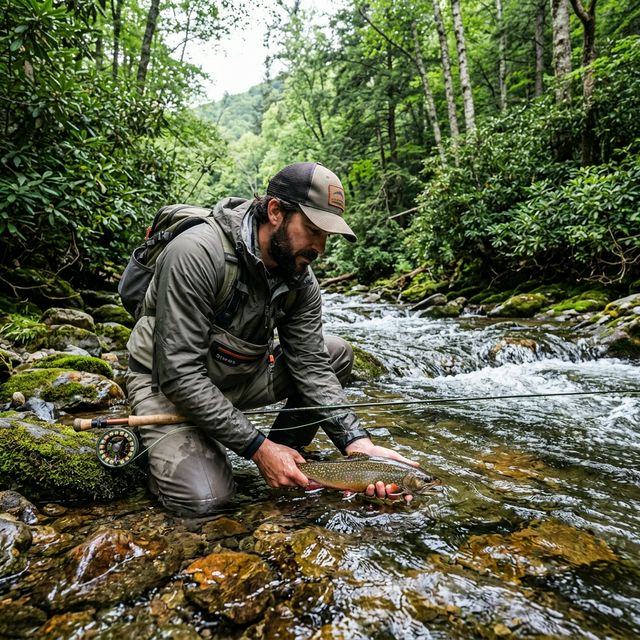
West Virginia’s trout program is one of the most distinctive in the eastern United States, featuring the Golden Rainbow Trout — a brilliant gold-colored strain developed exclusively by the WVDNR.
General Trout Rules
| Rule | Limit |
|---|---|
| Daily creel limit | 6 trout (all species aggregate) |
| Possession limit | 12 |
| Minimum size limit | 7 inches |
| Season | Year-round |
| Trout Stamp required | Yes — $10.00 resident (Class O), $16.00 non-resident (Class OO) |
Trout stamp exemptions: Holders of the Senior Sportsman (Class XS), Lifetime Combination (Class AB-L), 100% disabled veterans, former POWs, Class DT license holders, active duty military on leave, residents who turned 65 before Jan 1, 2012, and children under 15.
Species Stocked
West Virginia stocks five trout species/strains across 60+ streams and impoundments:
- Rainbow Trout — the most commonly stocked species
- Golden Rainbow Trout — West Virginia’s signature strain, brilliant gold coloring found almost nowhere else
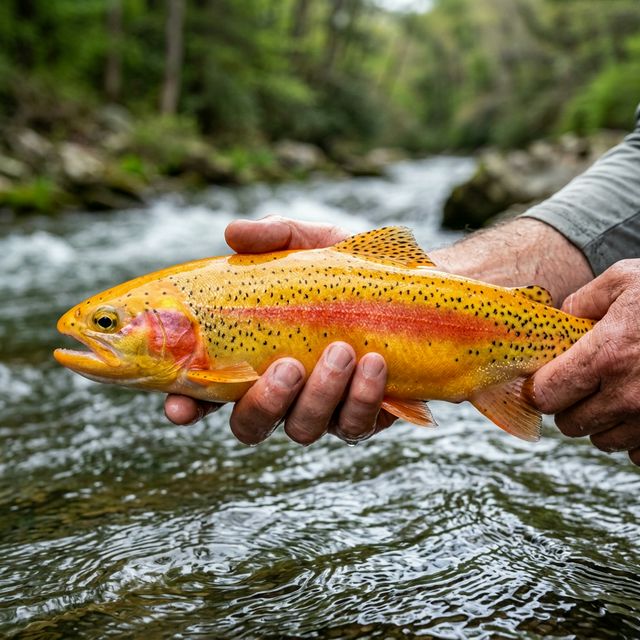
- Brook Trout — native to WV mountain streams, also stocked in select waters
- Brown Trout — stocked in streams with appropriate cold-water habitat
- Tiger Trout — brook trout × brown trout hybrid, stocked in limited numbers for diversity
Special Trout Management Areas
Catch-and-Release Areas (creel limit = 0): All trout must be immediately released unharmed.
- Artificial lures only
- Single, barbless hooks required
- No trout may be in the angler’s possession
- Examples: Sections of Cranberry River, Dogway Fork, Laurel Fork, Williams River
Delayed Harvest Streams: A two-phase regulation system that maximizes both conservation and harvest opportunity:
- No-Harvest Phase (typically October–May): Catch-and-release only, artificial lures with single barbless hooks
- Harvest Phase (typically June–September): General regulations apply, trout may be harvested (6/day, 7-inch minimum)
- Why this works: WVDNR stocks heavily during the no-harvest phase, building populations that provide excellent catch rates. When harvest opens in summer, stocked fish that haven’t been caught provide harvest opportunity while holdover trout fuel the next season.
Trophy Trout Waters: Designated waters with enhanced restrictions to produce larger fish:
- Daily creel limit: 2 trout
- Minimum size limit: 14 inches
Class Q Fishing Areas (March 1 – May 31)
Reserved exclusively for holders of the free Class Q permit (disabled anglers) and children 14 and under:
- Daily creel limit: 4 trout
- Standard size limits apply
- Waters revert to general regulations from June 1 through February 28

Rapala Stainless Steel Fishing Pliers
Stainless steel construction. Side cutter and split ring tool. Corrosion resistant.
As an Amazon Associate, we earn from qualifying purchases. Prices may vary.
Walleye, Sauger, and Saugeye Regulations
Walleye regulations are the most geographically variable rules in West Virginia. The statewide general limit is NOT the same as what applies on the Ohio River — this catches many non-resident anglers.
General Statewide Rules (Where No Special Regs Apply)
| Species | Daily Creel | Possession | Min. Size |
|---|---|---|---|
| Walleye | 8 | 16 | None |
| Sauger | 8 | 16 | None |
| Saugeye | 8 | 16 | None |
Ohio River and Kanawha River (Reciprocal Zone) — CRITICAL
The Ohio River (entire WV border) and Kanawha River from its mouth upstream to the Winfield Lock and Dam operate under the Ohio reciprocal agreement with significantly different limits:
| Rule | Limit |
|---|---|
| Aggregate daily creel (walleye + sauger + saugeye combined) | 6 total |
| Maximum walleye within aggregate | Only 2 may be walleye |
| Walleye minimum size | 18 inches |
| Aggregate possession limit | 12 |
This is the #1 walleye citation trap: The general WV walleye creel is 8, but on the Ohio River it’s an aggregate of 6 (walleye + sauger + saugeye combined), and only 2 of those may be walleye with an 18-inch minimum. Anglers familiar with WV’s general 8-fish limit routinely exceed these aggregate limits on the Ohio River. Conservation officers enforce this vigorously during spring walleye runs.
Walleye Slot Limit Waters (20-30 Inches)
Several river systems have a 20-to-30-inch slot limit for walleye. All walleye between 20 and 30 inches must be immediately released:
| Water | Daily Creel | Trophy Rule |
|---|---|---|
| Bluestone River (designated section) | 2 walleye | Only 1 over 30” |
| Coal River (designated section) | 2 walleye | Only 1 over 30” |
| Elk River (including Sutton Lake) | 2 walleye | Only 1 over 30” |
| Greenbrier River | 2 walleye | Only 1 over 30” |
| Gauley River (excl. Summersville Dam to Persinger Creek) | 2 walleye | Only 1 over 30” |
| New River (excl. no-harvest area near Sandstone) | 2 walleye | Only 1 over 30” |
Note: On these slot waters, walleye under 20 inches and over 30 inches may be harvested, but the daily creel limit is 2 (not 8), and only 1 may exceed 30 inches. These rivers and their tributaries are managed for trophy walleye production.
Other Special Walleye Rules
| Water | Min. Size | Daily Limit | Notes |
|---|---|---|---|
| Monongahela River | 15 inches | 8 | — |
| Tygart River | 15 inches | 8 | — |
| West Fork River | 15 inches | 8 | — |
| Burnsville Lake | 15 inches | 8 | — |

Plano 3700 Tackle Storage Box
Adjustable dividers. Durable construction. Perfect for organizing lures and tackle.
Affiliate link · Prices may vary
Musky (Muskellunge) Regulations
West Virginia’s musky fishing is concentrated in the Elk River drainage — one of the premier musky rivers in the central Appalachians.
General Statewide Rules
| Rule | Limit |
|---|---|
| Daily creel limit | 1 |
| Possession limit | 2 |
| Minimum size limit | 30 inches |
| Season | Year-round |
Special Musky Regulations
| Water | Regulation | Notes |
|---|---|---|
| Elk River (2-mile section, Randolph Co.) — Elk Springs Campground to Rose Run bridge | Catch-and-release only (creel = 0) | All musky must be released immediately |
| Jennings Randolph Lake | 36-inch minimum | Stricter than statewide standard |
The Elk River’s reputation: The Elk River from the Clay-Kanawha county line upstream is considered one of the top musky rivers in the eastern United States. The 30-inch minimum and 1-fish daily limit protect breeding-age fish while allowing harvest of truly trophy specimens. Musky anglers travel from across the country to fish this system, particularly during the fall and winter cold-water period when trophy fish are most active. The 2-mile catch-and-release section at the headwaters preserves a critical nursery area.
Other Species Quick Reference
| Species | Daily Creel | Possession | Minimum Size | Season |
|---|---|---|---|---|
| Channel Catfish | 8 | 16 | None | Year-round |
| Flathead Catfish | 2 | 4 | None | Year-round |
| Crappie | 15 | 30 | None | Year-round |
| Bluegill/Sunfish | 25 | 50 | None | Year-round |
| Rock Bass | 15 | 30 | None | Year-round |
| Northern Pike | 2 | 4 | 24 inches | Year-round |
| Paddlefish | 2 per season | — | None | Special season only; snagging permitted |
Prohibited Methods and Gear
The following methods are illegal in West Virginia:
- Use of explosives, poisons, or electrical devices to take fish
- Snagging (except during designated paddlefish season on specific waters)
- Use of live fish as bait in designated trout waters
- Fishing within 200 feet below a dam obstruction (on certain impoundments)
- Chumming with corn or other non-natural attractants in trout waters
- Fishing from a bridge on certain posted roadways
Noodling (hand-fishing): Taking catfish by hand is permitted in West Virginia in specific waters during designated seasons. Check the annual regulation summary for approved waters and dates.
2025-2026 Regulation Changes to Watch
- Several lakes (Elk Fork, North Bend, O’Brien, Woodrum) have transitioned from catch-and-release to minimum size limit regulations for black bass — a significant change allowing limited harvest with only 1 bass over 16 inches per day
- The WVDNR continues to expand its delayed harvest trout program to additional streams
- Walleye slot limit waters have been refined — verify your target river’s specific regulations before each trip
- Always download the current WVDNR Fishing Regulations Summary for the most up-to-date water-specific rules — regulations can change between annual summaries via emergency orders
Source: WVDNR 2025-2026 Fishing Regulations Summary and WV eRegulations, verified March 2026.