 FishKillFlea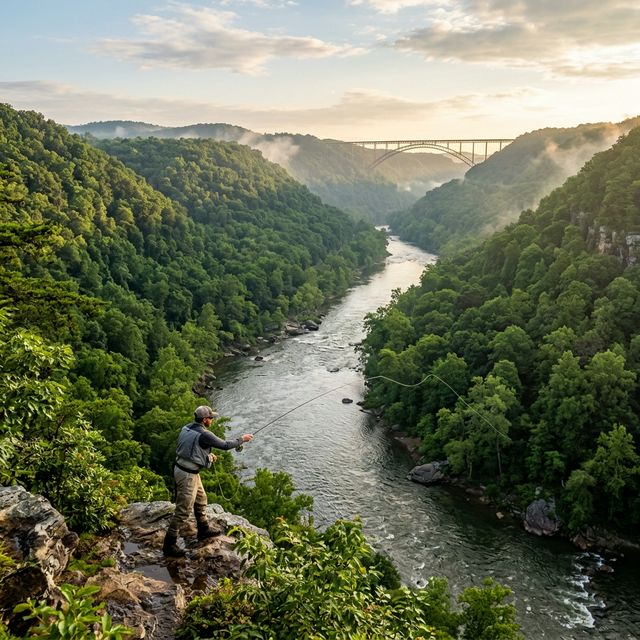
You’ve been following Route 19 south through the mountains for an hour, the road carving through tunnels of rhododendron and hemlock, when the valley suddenly drops away and you’re staring down at the New River Gorge — 800 feet of near-vertical sandstone and one of the most iconic bridges in America stretching across the gap. Your buddy from Virginia told you West Virginia has some of the best smallmouth bass fishing east of the Mississippi, and he wasn’t exaggerating. What he forgot to mention: your Virginia license won’t cover a single cast here, and the licensing system involves layers of stamps that catch first-time visitors off-guard.
West Virginia’s fishing license structure operates on a base license plus stamps model. Your non-resident fishing license (Class F) covers warmwater species — bass, catfish, walleye, sauger, musky — across the state’s 20,000 miles of fishable streams and over 100 public fishing lakes. But the moment you want to target trout, you need a separate Trout Stamp. And every non-resident licensed angler, regardless of what species they’re chasing or which license type they hold, needs a Conservation/Law Enforcement Stamp on top of their base license.
The Mountain State sits at the heart of the central Appalachian fishing corridor, bordered by five states and offering water types that range from thundering whitewater smallmouth rivers like the New and Gauley to gentle limestone spring creeks in the Eastern Panhandle to the wide, slow Ohio River forming the entire western border. For the money, West Virginia delivers more fishing variety per dollar than nearly any state in the region.
Non-Resident License Types and Costs
All prices listed are base license fees. Online purchases add a $2.00 transaction fee; retail agent purchases add a $3.00 issuing fee (first purchase) or $1.00 (subsequent).
| License Type | Class | Duration | Base Price | Conservation Stamp (CS/LE) | Trout Stamp (OO) | True Total (warmwater) | True Total (all-species) |
|---|---|---|---|---|---|---|---|
| NR Annual Fishing | F | Jan 1 – Dec 31 | $37.00 | $13.00 (required) | $16.00 (if trout) | $50.00 | $66.00 |
| NR 1-Day Fishing | LL | 1 calendar day | $3.00 | $13.00 (required) | Not available | $16.00 | N/A — no 1-day trout |
| NR Junior Sportsman (ages 8-17) | XXJ | Calendar year | $16.00 | Included | Not included ($16.00 extra) | $16.00 | $32.00 |
The 1-Day License (Class LL) reality check: The $3.00 base price sounds incredible, but every non-resident licensed angler — including 1-day holders — must purchase the $13.00 Conservation/Law Enforcement Stamp. Your true 1-day warmwater cost is $16.00, not $3.00. And because there is no standalone 1-day trout option, anglers who want to fish for trout even for a single day must purchase the full annual package ($66.00). The 1-day license is best for a quick bass trip where you already hold the Conservation Stamp from an earlier purchase that same calendar year.
Junior Sportsman (Class XXJ) clarification: The XXJ license is available for non-residents ages 8 through 17 and includes hunting, fishing, and trapping privileges. It bundles the Conservation Stamp, but does not include the Trout Stamp. If your teen wants to fish for trout, the $16.00 Trout Stamp (Class OO) must be purchased separately. Children under 15 don’t need any license in West Virginia, so the XXJ is only mandatory for non-resident youth ages 15-17 who want to fish. Youth 8-14 may optionally purchase it for hunting/trapping privileges.
Source: WVDNR Hunting & Fishing License Fees and WV eRegulations, verified March 2026.
Total Cost Scenarios for Non-Residents
| Scenario | What You Buy | True Total |
|---|---|---|
| Quick 1-day bass trip (warmwater only) | 1-Day (LL) + Conservation Stamp (CS/LE) | $16.00 |
| Second 1-day trip same year (stamp already purchased) | 1-Day (LL) only | $3.00 |
| Annual bass, walleye, musky (no trout) | Annual (F) + Conservation Stamp (CS/LE) | $50.00 |
| Annual all-species including trout | Annual (F) + Trout Stamp (OO) + Conservation Stamp (CS/LE) | $66.00 |
| Youth angler age 15-17, warmwater only | Junior Sportsman (XXJ) | $16.00 |
| Youth angler age 15-17, including trout | Junior Sportsman (XXJ) + Trout Stamp (OO) | $32.00 |
| Child under 15, any species | Nothing | Free |
The Conservation Stamp carry-over trick: The $13.00 Conservation/Law Enforcement Stamp is valid for the entire calendar year once purchased. If you buy a 1-day license in April ($16.00 total), then decide to return in September, your second 1-day license costs only $3.00 because you already hold the stamp. This makes the 1-day option more attractive for repeat warmwater visitors who take multiple short trips per year.
Break-Even: Annual vs Multiple 1-Day Licenses
Since the Conservation Stamp applies to both annual and 1-day options, the real comparison is:
- First 1-day trip: $16.00 (LL + CS/LE stamp)
- Each additional 1-day trip same year: $3.00 (LL only)
- Annual warmwater (F + CS/LE): $50.00
The annual license breaks even at 12 single-day trips after the first one (1 × $16.00 + 11 × $3.00 = $49.00 vs $50.00 for the annual). If you fish West Virginia more than a dozen days per year, the annual is the clear winner — plus it gives you the flexibility to fish any day spontaneously.
For trout fishing, there’s no comparison: the annual all-species package ($66.00) is your only option regardless of how many days you plan to fish, since there is no 1-day trout stamp.

Piscifun Fishing Tackle Backpack
Large capacity fishing backpack with tackle boxes. Waterproof rain cover included.
Affiliate link · Prices may vary
How to Buy: Three Purchase Channels
1. WVhunt.com — Online (Recommended)
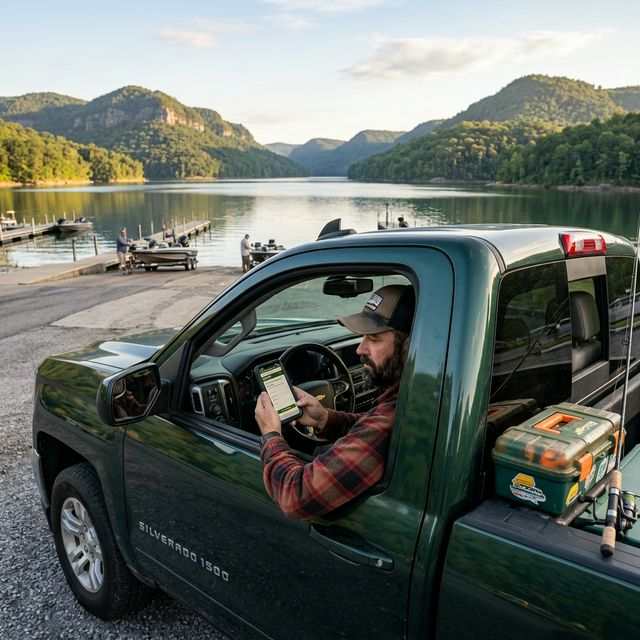
The WVDNR’s electronic licensing portal is available 24/7 and accepts credit/debit cards. Your license is available immediately as a printable PDF or can be stored digitally on your phone. A $2.00 transaction fee applies per purchase session. Create an account for easy future purchases — the system stores your information year to year and lets you reprint licenses if lost.
Important for non-residents: You’ll need your driver’s license number or state ID number, plus your Social Security number (or last 4 digits) to create an account. Have these ready before you start.
2. By Phone
Call the WVDNR Hunting and Fishing License Unit at (304) 558-2758 during business hours (Monday–Friday, 8:00 AM – 5:00 PM Eastern). Phone purchases include the same $2.00 transaction fee. A confirmation can be mailed to your home address.
3. In-Person Retail Agents
Over 160 locations statewide sell West Virginia fishing licenses: Walmart stores, local tackle shops, hardware stores, and sporting goods retailers across all 55 counties. A $3.00 issuing fee applies to your first license purchase, with a $1.00 fee for each subsequent license or stamp purchased during the same transaction.
Pro tip for road-trippers: If you’re driving through on I-64, I-77, or I-79, the Walmart stores near Beckley, Charleston, and Morgantown are reliable license agents with long hours. But if you’re heading to remote mountain trout streams in Pocahontas or Randolph County, buy online before you leave — many mountain towns have limited retail hours and spotty cell service that won’t load WVhunt.com.

Plano Guide Series Rod Tube Case
Hard-shell rod tube protects rods during travel. Airline-approved for checked baggage.
As an Amazon Associate, we earn from qualifying purchases. Prices may vary.
The Stamp Stack: What Goes on Top of Your License
West Virginia’s stamp system is the biggest source of confusion for first-time non-resident visitors. Here’s exactly what you need and why:
Conservation/Law Enforcement Stamp (Class CS/LE) — $13.00
Required for every non-resident licensed angler, regardless of species or license type — including 1-day license holders. This is the stamp that most first-time visitors miss. It funds conservation officers, habitat restoration, stream access programs, and the state’s fish stocking operations. The only non-residence exemptions are children under 15 (who need no license at all).
Non-Resident Trout Stamp (Class OO) — $16.00
Required for any non-resident angler targeting trout in any waters. West Virginia is home to the Golden Rainbow Trout — a strain developed exclusively by the WVDNR that produces brilliant gold-colored rainbow trout stocked in select waters throughout the state. The state stocks over 60 streams and impoundments with rainbow, golden rainbow, brook, tiger, and brown trout, with major stockings in spring (March–May) and fall (October–November).
Where you’ll get caught: Conservation officers focus enforcement on popular trout stocking sites near Elkins, the Cranberry Wilderness area, Seneca Creek, and the North Fork of the South Branch Potomac — all prime non-resident destinations. Missing the trout stamp is the single most common citation for visiting anglers.
What’s NOT Required
Unlike many states, West Virginia does not charge separate stamps for bass, walleye, musky, or other warmwater/coolwater species. Your base Class F license plus the Conservation Stamp covers all non-trout species. There is no separate “Sportfish,” “Musky,” or “Bass” endorsement — a welcome simplicity in a system that already requires two stamps for trout anglers.

KastKing Blackhawk II Telescoping Rod
Portable telescoping design collapses to 17 inches. Perfect for travel fishing.
Affiliate link · Prices may vary
Border Water Rules: The Ohio River Exception
West Virginia shares borders with five states — Virginia, Kentucky, Ohio, Pennsylvania, and Maryland — creating some of the most complex border-water jurisdictions in the eastern U.S.
Ohio River (WV/OH Border) — Reciprocal Agreement
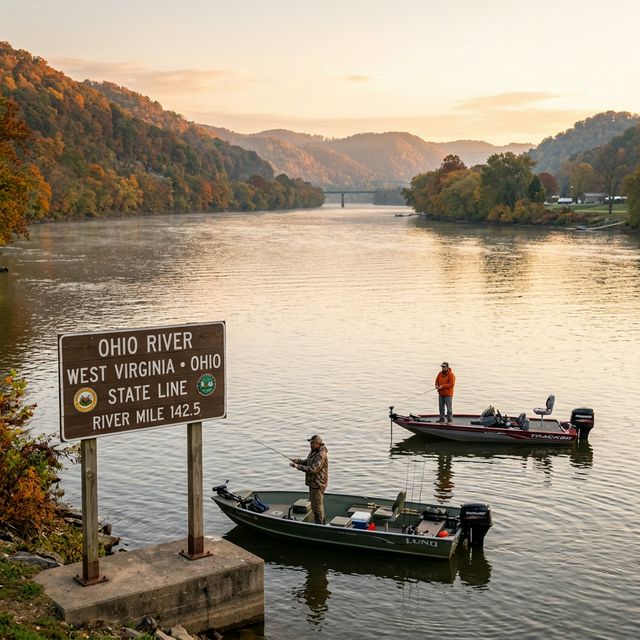
The Ohio River forms West Virginia’s entire western border, running over 277 miles from the Northern Panhandle to Point Pleasant. A reciprocal agreement with Ohio means:
- A valid fishing license from either West Virginia or Ohio allows you to fish the main channel of the Ohio River from either bank, including embayments
- The reciprocal zone extends to the Kanawha River upstream to the Winfield Lock and Dam — beyond that point, WV-only jurisdiction applies
- Walleye regulations under the reciprocal agreement: 18-inch minimum size limit, daily creel limit of 2 walleye, with an aggregate daily limit of 6 for walleye, sauger, and saugeye combined (of which only 2 may be walleye)
- Tributaries beyond the reciprocal zone are NOT covered: Once you pass the Winfield Lock and Dam on the Kanawha, or enter the Little Kanawha River, Elk River, or any other tributary, you’re under West Virginia-only jurisdiction and need a WV license
Tug Fork (WV/KY Border) — No General Reciprocity
The Tug Fork River separates West Virginia from Kentucky for approximately 160 miles through the heart of coal country. There is no general reciprocal agreement. West Virginia and Kentucky each require their own license for their respective sides. The boundary splits roughly at the thread of the stream — wade across the centerline and you’ve changed jurisdiction.
South Branch Potomac / Potomac River (WV/VA/MD Border) — Complex Jurisdiction
The Potomac River and its tributaries in the Eastern Panhandle involve three-state jurisdiction. The Potomac River’s main stem is under Maryland’s jurisdiction entirely (even on the West Virginia bank) — you need a Maryland license to fish the main stem Potomac, regardless of which bank you’re standing on. However, West Virginia tributaries like the South Branch of the Potomac (an exceptional smallmouth fishery with a 12-to-20-inch slot limit on certain sections) are solely under WV jurisdiction.
No Other Reciprocal Agreements
West Virginia has no reciprocal fishing agreements with Virginia, Pennsylvania, Maryland, or Kentucky beyond the Ohio River arrangement. If you’re crossing state lines in the Appalachian region, budget for separate licenses in each state you plan to fish.
Neighboring State Price Comparison (2025-2026 Verified)
| State | NR Annual Base | NR Trout Stamp | Total (All Species) | Cheapest Short-Term | Key Species | Source |
|---|---|---|---|---|---|---|
| West Virginia | $37.00 + $13.00 CS/LE | $16.00 | $66.00 | $16.00 (1-day + stamp) | Golden rainbow trout, New River smallmouth, Elk River musky | wvdnr.gov |
| Virginia | $47.00 | $23.00 (Oct 1 – Jun 15 only) | $70.00 | $16.00 (5-day trip) | Stocked trout, James River smallmouth | dwr.virginia.gov |
| Kentucky | $55.00 | $10.00 | $65.00 | $15.00 (1-day) | Lake Cumberland bass, Cumberland trout tailwater | fw.ky.gov |
| Ohio | $50.96 | Included in base | $50.96 | $14.00 (1-day) | Lake Erie walleye, steelhead | ohiodnr.gov |
| Pennsylvania | $60.97 | $14.97 | $75.94 | $31.97 (3-day tourist, trout incl.) | Limestone spring creeks, Lake Erie steelhead | pa.gov |
| Maryland | $55.00 | $30.00 | $85.00 | $35.00 (3-day) | Chesapeake Bay, Deep Creek Lake | dnr.maryland.gov |
Key insights from the comparison:
- Cheapest all-species annual: Ohio at $50.96 (trout included) — but Ohio’s trout program is tiny compared to West Virginia’s
- Cheapest trout-focused: Kentucky at $65.00 total — but KY’s trout water is concentrated in a few tailraces, while WV has 60+ stocked streams
- Most expensive: Maryland at $85.00 ($55 + $30 trout stamp) — a 29% premium over WV
- Virginia’s trout stamp seasonal quirk: Virginia requires the $23.00 trout stamp only from October 1 through June 15; from June 16 through September 30, you can fish stocked trout waters without it
- West Virginia’s unique value: The $66.00 all-species total buys access to the Golden Rainbow Trout, 60+ stocked streams, the New River Gorge smallmouth fishery, and Elk River musky — more species diversity per dollar than any neighboring state
Enforcement and Penalties: What Non-Residents Should Know
West Virginia conservation officers (Natural Resources Police) conduct routine license checks on popular waters, boat launches, and stocked trout streams — particularly during spring stocking season and on weekends. Non-residents are checked at the same rate as residents.
Penalties for fishing without a valid license (per WV Code §20-7-1b):
| Violation | Penalty Range |
|---|---|
| First offense — no license | Fine of $100 to $500 + court costs, or 10-100 days jail, or both |
| No Conservation Stamp | Same penalty schedule as no-license violation |
| No Trout Stamp (fishing trout waters) | Same penalty schedule; fishing equipment may be confiscated |
| Repeat offenses | Escalating fines; potential loss of ALL fishing privileges statewide |
The Conservation Stamp citation trap: The most common non-resident violation isn’t fishing without a license — it’s fishing without the Conservation Stamp. Many visitors buy their Class F license online but don’t realize the CS/LE stamp is a separate, mandatory purchase. Officers will cite you for the missing stamp even if your base license is valid. Always verify your WVhunt.com receipt shows both the license AND the stamp.
Planning a Multi-State Appalachian Trip
The “Mountain Bass Grand Slam” Circuit
West Virginia sits at the geographic center of Appalachian bass fishing. A classic 5-day circuit:
- Day 1-2: New River Gorge, WV — wade the catch-and-release zones below Sandstone Falls for trophy smallmouth (WV annual warmwater: $50.00)
- Day 3: Virginia’s James River — float the Balcony Falls section for 20-inch smallmouth (VA NR license: $47.00)
- Day 4-5: Kentucky’s Elkhorn Creek — wade the outstanding smallmouth water near Frankfort (KY NR 1-day: $15.00 × 2 = $30.00)
Total for 5 days, three states (bass only): $127.00. A remarkable value for five days of fishing on three of the best smallmouth rivers in eastern America.
The Appalachian Trout Trail
For the trout-focused visitor, combine:
- West Virginia: Cranberry River and Williams River (Golden Rainbow and native brook trout in the Monongahela National Forest) — $66.00 total
- Virginia: Mossy Creek or the Jackson River tailwater — $70.00 (base + trout stamp)
- Pennsylvania: Penns Creek or Spring Creek in Centre County — $31.97 (3-day tourist, trout included)
Total for a week-long trout expedition across three states: $167.97. West Virginia’s Cranberry Wilderness offers native brook trout fishing that rivals the Great Smoky Mountains — and with far fewer anglers on the water. The Golden Rainbow Trout, exclusive to West Virginia, is a catch available nowhere else in the world.
The Ohio River Walleye Run
Every spring, walleye run up Ohio River tributaries in both West Virginia and Ohio. The reciprocal agreement makes this a natural two-state trip: fish the main Ohio River channel with either state’s license, then add WV-specific tributaries (Elk River, Little Kanawha) for the full experience. Keep in mind the reciprocal zone’s 2-walleye daily limit (6 aggregate with sauger/saugeye) and 18-inch minimum size. A WV annual warmwater ($50.00) plus an OH annual ($50.96) costs $100.96 and covers both states’ waters from February through April.
Seasonal Calendar for Non-Resident Planning
| Season | Best Targets | Where | License Needed |
|---|---|---|---|
| March–May | Trout stocking runs, spring bass | Cranberry River, Williams River, New River | Annual + Trout Stamp ($66.00) |
| May–July | Smallmouth bass (peak), musky | New River, Greenbrier River, Elk River | Annual warmwater ($50.00) |
| July–September | Warmwater panfish, catfish, bass | Ohio River, Stonewall Jackson Lake | 1-day ($16.00) or annual |
| October–December | Fall trout stocking, trophy musky | Cranberry area, Elk River (musky) | Annual + Trout Stamp ($66.00) |
| January–February | Winter musky, cold-water walleye | Elk River, Ohio River tributaries | Annual warmwater ($50.00) |