 FishKillFlea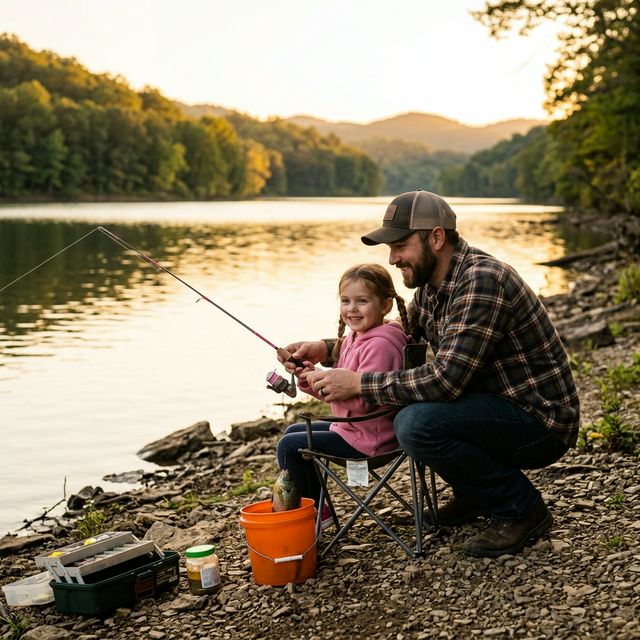
Your five-year-old daughter pulls back on the rod with both hands and a bluegill the size of her palm breaks the surface of Beech Fork Lake, scattering droplets across the warm June air like tiny diamonds. She turns to you with a grin that makes the whole drive from Charleston worth it. You don’t need to worry about whether she has a license — in West Virginia, she won’t need one for another ten years. And when you tell her the fish she just caught is entirely hers (it counts toward her own bag limit, not yours), she insists on keeping it for the family’s dinner.
West Virginia’s approach to youth fishing is simple and generous: under 15, you fish free. No license. No trout stamp. No conservation stamp. No forms to fill out, no identification to carry. This applies equally to residents and non-residents — a family from Ohio driving across the border for a weekend at Stonewall Jackson Lake State Park doesn’t need to buy licenses for any child under 15. The state recognizes that the path to a lifetime of fishing (and license-buying) starts with barrier-free access for kids.
Age-Based License Requirements at a Glance
| Age | License Required? | License Type | Cost | Trout Stamp? | Conservation Stamp? |
|---|---|---|---|---|---|
| Under 15 | No | None needed | Free | Not needed | Not needed |
| 15-17 (Resident) | Yes | Junior Sportsman (XJ) | $16.00 | ❌ Separate ($10.00) | ✅ Included |
| 15-17 (Non-Resident) | Yes | Junior Sportsman (XXJ) | $16.00 | ❌ Separate ($16.00) | ❌ Separate ($13.00) |
| 8-14 (Non-Resident) | No (exempt) | XXJ available but not required | $16.00 if purchased | N/A | N/A |
| 18+ (Resident) | Yes | Standard adult licenses | $19.00+ | Separate ($10.00) | Separate ($5.00) |
| 18+ (Non-Resident) | Yes | Standard adult licenses | $37.00+ | Separate ($16.00) | Separate ($13.00) |
The under-15 advantage: West Virginia’s free-fishing-under-15 rule is remarkably broad. It applies to all species (including trout), all waters (including catch-and-release areas, subject to gear restrictions), and all residency statuses. Many other states set the youth exemption at under 16, but West Virginia’s under-15 cutoff still represents a strong commitment to barrier-free youth access.
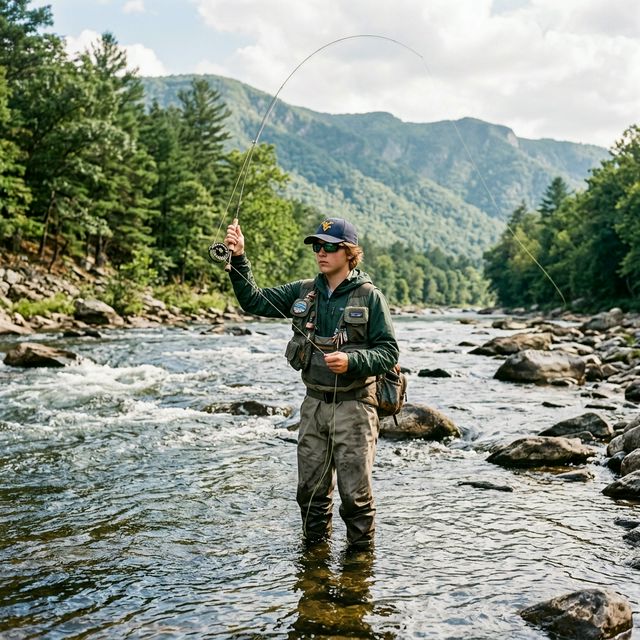
Critical trout stamp note for parents of 15-17 year olds: The Junior Sportsman license (XJ/XXJ) does NOT include the trout stamp. If your teenager plans to fish for trout — including at stocked streams — they need a separate Trout Stamp: $10.00 (resident Class O) or $16.00 (non-resident Class OO). This is the single most common compliance mistake for youth anglers in West Virginia.
Source: WVDNR License Requirements, WV Code §20-2-27, and WV eRegulations, verified March 2026.
The Junior Sportsman License: Ages 15-17
When your child turns 15, they enter the licensing system — but West Virginia makes the transition affordable with a youth-priced license.
Resident Junior Sportsman (Class XJ) — $16.00
Available for West Virginia residents aged 15 through 17. This single license covers:
| Included Privilege | Equivalent Adult License | Adult Price |
|---|---|---|
| Fishing (all warmwater/coolwater species) | Class B | $19.00 |
| Hunting | Class A | $19.00 |
| Trapping | Class C | $19.00 |
| Conservation/Law Enforcement Stamp | Class CS | $5.00 |
| Total adult equivalent | — | $62.00 |
NOT included (must purchase separately if needed):
- Trout Stamp (Class O): $10.00 — required for trout fishing
- Bear Damage Stamp: $3.50
At $16.00 for the base license, the XJ represents a 74% discount compared to purchasing equivalent adult licenses for warmwater fishing. Including trout, the total youth cost is $26.00 versus $72.00 adult — still a 64% savings.
Non-Resident Junior Sportsman (Class XXJ) — $16.00
Available for non-resident youth aged 8 through 17 (note the broader age range than resident XJ). The XXJ costs the same $16.00 as the resident version, which is unusual — most states charge non-resident youth significantly more.
However, the XXJ has additional costs that the XJ does not:
| Item | Price | Required? |
|---|---|---|
| Junior Sportsman (XXJ) base | $16.00 | Yes |
| Conservation/Law Enforcement Stamp (LE) | $13.00 | Yes — not included |
| Trout Stamp (OO) | $16.00 | Only if fishing for trout |
| Minimum for all-species fishing | $45.00 | — |
The non-resident youth cost reality: While the base XXJ license is only $16.00 — the same as resident youth — the additional mandatory conservation stamp ($13.00) and optional trout stamp ($16.00) bring the total to $29.00 for warmwater or $45.00 for trout fishing. This is significantly more than the resident youth total of $16.00 (warmwater) or $26.00 (with trout). Parents should factor in these add-ons when budgeting a cross-border fishing trip.
Apprentice Junior License (Class AHJ/AAHJ) — $16.00
An alternative youth license with identical cost, the Apprentice Junior license is designed for young anglers who want mentored instruction. It includes the same XJ/XXJ privileges and connects youth with the state’s mentored outdoor education programs. The same trout stamp and conservation stamp rules apply.

Thkfish Fishing Accessories Kit
Complete terminal tackle kit with hooks, sinkers, swivels, and bobbers. Everything in one box.
Affiliate link · Prices may vary
How Children’s Catch Counts
One of the most common questions from parents fishing with young children — and the answer is more favorable than most expect:
Under 15 (License Exempt)
- Each child has their OWN daily creel limit — identical to the adult limit for each species
- Fish caught by the child count toward the child’s individual limit, NOT the parent’s limit
- The child must comply with all size limits and gear restrictions just like an adult
- In catch-and-release waters, children must release fish regardless of their license-exempt status
- In slot limit waters (New River, Ohio River, etc.), children must follow the same slot rules as adults
Ages 15-17 (Junior Sportsman)
- Standard adult creel limits apply
- If the Junior Sportsman license holder has purchased a trout stamp, they can keep trout from stocked waters
- All special regulations (slot limits, catch-and-release designations) apply equally to Junior Sportsman holders
- Possession limits (typically 2× daily creel) apply the same as for adults
Practical example: You and your 8-year-old are fishing Stonewall Jackson Lake. The bass regulation allows 1 bass 18 inches or longer per day for each angler. If you both catch an 18-inch bass, you can keep both — one counts against your limit, one against your child’s. Your child does not need a license at age 8, but they still have their own independent daily creel limit.
What you CANNOT do: An adult cannot claim a child’s bag limit to exceed their own. If an officer observes you in possession of more than your creel limit, attributing extra fish to your exempt child requires that the child actually caught them. Misrepresenting possession limits is a violation regardless of who’s present.
Class Q Fishing Areas: The Youth Advantage
West Virginia’s Class Q Fishing Areas aren’t just for disabled anglers — they’re also open to children age 14 and under. These special waters offer an exceptional youth fishing experience:
Why Class Q areas are ideal for kids:
- Heavily stocked: Trout are stocked specifically for these waters from March through May
- Less pressure: Limited to Class Q permit holders and children — far fewer anglers competing for stocked fish
- Accessible shoreline: Most Class Q areas feature paved paths and platforms designed for easy access — ideal for strollers and little legs
- Predictable success: The combination of heavy stocking and limited anglers means high catch rates — exactly what keeps a young angler interested
- No license bureaucracy: Children under 15 need zero paperwork to fish these waters
Class Q youth season: March 1 – May 31. Children 14 and under can fish these waters without any license or permit. Daily limit: 4 trout. Standard size limits (7-inch minimum) apply.

Zebco 33 Spincast Combo
Classic push-button reel. No tangles, no backlash — ideal for seniors and beginners.
As an Amazon Associate, we earn from qualifying purchases. Prices may vary.
West Virginia Kids Fishing Events
2026 Free Fishing Days — June 13-14
West Virginia designates Free Fishing Days each year — in 2026, the dates are June 13-14 (Saturday-Sunday). During this weekend, anyone — resident or non-resident, any age — can fish without a license:
- No license, stamp, or permit required for any angler during the entire weekend
- All standard regulations (creel limits, size limits, catch-and-release areas) still apply
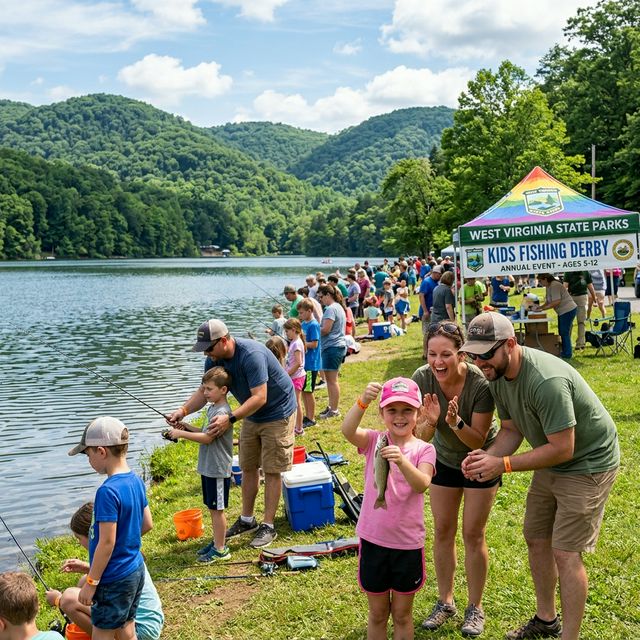
- State parks and local organizations host special events, instruction clinics, and fishing derbies
- This is the single best weekend to introduce a child to fishing — the entire state is oriented toward welcoming new anglers
Plan ahead: Free Fishing Days are among the busiest fishing weekends of the year at accessible state park waters. Arrive early for prime spots at popular locations like Beech Fork, Stonewall Jackson Lake, and North Bend State Park. Less crowded alternatives include smaller impoundments and stream sections — check the WVDNR stocking schedule to find recently stocked waters near your location.
WVDNR Kids Fishing Derbies
The Division of Natural Resources, in partnership with West Virginia State Parks, hosts kids fishing derbies throughout the spring and summer at state park lakes across the state. These events typically include:
- Specially stocked ponds and lake sections with high catch rates
- Free loaner fishing equipment (rods, reels, tackle)
- Basic instruction for beginners (casting, knots, bait rigging)
- Prizes for largest fish, most fish caught, and youngest angler categories
- Free food and family activities
Check the WVDNR events calendar for current derby schedules. Popular locations include Beech Fork State Park, North Bend State Park, Stonewall Jackson Lake State Park, and Canaan Valley State Park.
Trout in the Classroom
The WVDNR’s Trout in the Classroom program partners with schools across West Virginia to raise trout from eggs in classroom aquariums, then release them into local streams. Students learn about aquatic ecology, water quality, and conservation — and many develop their first interest in fishing through the program. Over 100 West Virginia schools have participated. Contact your local WVDNR district office for information about participating schools.
Neighboring State Comparison: Youth Fishing Ages
| State | License-Free Age | Youth License | Youth Cost (Resident) | NR Youth Same Price? | Trout Included? | Source |
|---|---|---|---|---|---|---|
| West Virginia | Under 15 | XJ (ages 15-17) | $16.00 | ✅ Same base price | ❌ No | wvdnr.gov |
| Virginia | Under 16 | None — adult at 16 | $23.50 | ❌ No | Separate permit | dwr.virginia.gov |
| Kentucky | Under 16 | None — adult at 16 | $23.00 | ❌ No | Separate permit | fw.ky.gov |
| Ohio | Under 16 | None — adult at 16 | $25.00 | ❌ No | Separate permit | ohiodnr.gov |
| Pennsylvania | Under 16 | Voluntary youth | $2.97 (voluntary) | N/A | Separate permit | pa.gov |
| Maryland | Under 16 | None — adult at 16 | $20.50 | ❌ No | Separate | dnr.maryland.gov |
Analysis: Where WV Youth Licensing Stands
Strengths:
- The $16.00 Junior Sportsman all-in-one is the best-value mandatory youth license in the region — Virginia and Kentucky jump immediately to full adult pricing at 16
- Non-resident youth base price is identical to resident ($16.00) — unusual generosity
- Under-15 exemption includes all species including trout — no stamp needed for children
- Class Q waters give children exclusive access to stocked trout — unique in the Appalachian region
Weaknesses:
- The under-15 cutoff is lower than most neighboring states (under 16) — one year less of free fishing
- XJ/XXJ does NOT include trout stamp — a significant hidden cost that catches families off guard
- Non-resident XXJ requires a separate $13.00 conservation stamp, making the total cost ($29-45) much higher than the $16.00 base suggests

Eagle Claw Snelled Hook Assortment
Pre-tied hooks ready to use. Great for live bait fishing.
Affiliate link · Prices may vary
Building a Young Angler: Best Starter Spots in WV
For parents planning their child’s first fishing experience, these West Virginia waters offer the best combination of access, fish density, and family facilities:
| Location | County | Best For | Why It Works for Kids |
|---|---|---|---|
| Beech Fork State Park | Wayne | Bluegill, crappie | Shallow coves, accessible pier, campground with restrooms |
| Stonewall Jackson Lake | Lewis | Bass, crappie | Lodge facilities, multiple piers, easy shore access |
| North Bend Lake | Ritchie | Bluegill, catfish | Quiet state park, gentle shoreline, rail-trail nearby |
| Burnsville Lake | Braxton | Crappie, bass | Army Corps facilities, covered picnic areas lakeside |
| Canaan Valley State Park | Tucker | Stocked trout | Flat terrain, accessible pond, mountain scenery |
| Class Q waters | Various | Stocked trout | Reserved for kids under 15 (and Class Q holders), highest catch rates |
Lifetime License: An Investment in Your Child’s Fishing Future
For families committed to raising West Virginia anglers, purchasing a Lifetime Fishing License while your child is young locks in today’s prices permanently:
| Child’s Current Age | Lifetime Fishing (B-L) | Lifetime Combo (AB-L) | Includes Trout? | Annual Savings Begins |
|---|---|---|---|---|
| Under 1 | $220.80 | $322.00 | B-L: No / AB-L: Yes | Age 15 |
| 1-4 | $303.60 | $442.75 | B-L: No / AB-L: Yes | Age 15 |
| 5-9 | $414.00 | $603.75 | B-L: No / AB-L: Yes | Age 15 |
| 10-14 | $496.80 | $724.50 | B-L: No / AB-L: Yes | Age 15 |
The AB-L eliminates the trout stamp problem: Since the fishing-only B-L does NOT include trout, a child with a B-L would still need an annual trout stamp ($10.00/year) or Lifetime Trout Stamp (O-L, $92.00–$207.00 depending on age). The Combination AB-L includes trout permanently — making it the cleaner choice for families who want zero annual purchases ever again.
A Lifetime Combination license purchased for an infant at $322.00 avoids all future licensing costs — no Junior Sportsman at 15, no adult licenses at 18, no annual renewals, no trout stamp purchases. By the child’s mid-20s (after ~11 years of licensing at $50+/year), the investment has fully paid for itself and every year after is pure savings.
Source: WVDNR License Requirements and WV Code §20-2-27, verified March 2026.