 FishKillFlea
· Guides · 10 min read
Fishing License Reciprocity: Which States Honor Each Other's Licenses? (2026)
Reviewed by FishKillFlea Editorial Team
The only complete guide to fishing license reciprocity in America. Find out which border waters accept either state's license, which states have mutual agreements, and where you absolutely need two licenses.
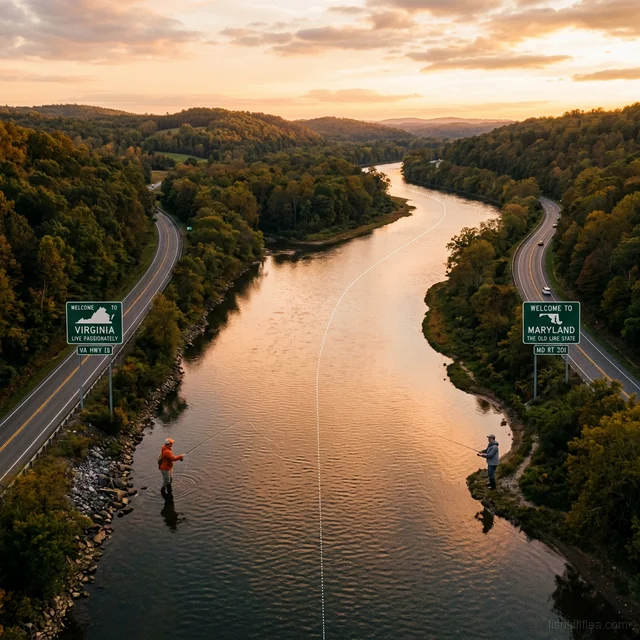
There is no universal multi-state fishing license in America — but there ARE specific reciprocal agreements between neighboring states that let you fish shared waters with just one license. The problem? This information is scattered across dozens of state regulation books, and no single resource has ever compiled it all. Until now.
This guide documents every known fishing license reciprocity agreement between US states, covering border rivers, shared lakes, and the rare inland reciprocity compacts.
The Rule vs. The Exceptions
The rule (95% of cases): Your fishing license is valid ONLY in the state that issued it. Period.
The exceptions: Certain border waters — rivers, lakes, and reservoirs that physically sit on state boundaries — have reciprocal agreements where either state’s license works within a defined zone. These agreements exist because it’s impractical to enforce two separate licenses on a river where the state line runs down the middle.
Critical distinction: Reciprocity applies to specific waters, not to entire states. Having a Virginia license doesn’t let you fish anywhere in North Carolina — only on the specific shared waters covered by the VA-NC agreement.

Piscifun Fishing Tackle Backpack
Large capacity fishing backpack with tackle boxes. Waterproof rain cover included.
Affiliate link · Prices may vary
Complete Reciprocity Map: Every Known Agreement
🟢 Full Reciprocity (Either State’s License Works)
These border waters have formal agreements where a valid fishing license from either bordering state allows you to fish throughout the shared water:
| Shared Water | States | What’s Covered | Key Conditions |
|---|---|---|---|
| Lake Texoma | Texas — Oklahoma | Most of the lake within reciprocal zone (marked by buoys) | TX offers a special $12 Lake Texoma license; OK license also valid. You must follow the regulations of the state whose waters you’re in |
| Lake Powell | Utah — Arizona | Entire lake | Either state’s license works anywhere on the lake. Buy whichever is cheaper |
| Lake Mead | Nevada — Arizona | Entire lake | Either state’s license works. AZ license tends to be cheaper |
| Columbia River | Oregon — Washington | Columbia River mainstem + tributaries to first bridge | Both states include Columbia River reciprocity in their standard fishing license. Salmon/steelhead tags still state-specific |
| Buggs Island Lake (Kerr Reservoir) | Virginia — North Carolina | Entire reservoir | Either state’s license is valid throughout. Both states honor the agreement |
| Gaston Lake | Virginia — North Carolina | Entire reservoir | Same VA-NC reciprocity as Kerr Reservoir |
| New River (shared section) | Virginia — North Carolina | Border segment of the New River | VA or NC license valid in shared waters |
| South Holston Reservoir | Tennessee — Virginia | Entire reservoir | Either TN or VA freshwater license valid, BUT a special South Holston Reservoir License is also required (available from either state) |
| Dale Hollow Lake | Tennessee — Kentucky | Entire reservoir | Either state’s license is valid on the lake |
| Lake Cumberland (Wolf Creek Dam tailrace) | Kentucky — Tennessee | Shared tailwater areas | Either state’s license valid in designated shared zones |
🟡 Partial Reciprocity (Shared Border Waters with Conditions)
These agreements cover specific border waters with more restrictive conditions:
| Shared Water | States | Agreement Details | Conditions |
|---|---|---|---|
| Mississippi River (main channel) | MN-WI, IA-IL, MO-IL, MO-KY, TN-AR, MS-LA, MS-AR | Generally: license from launching state covers main channel | You must follow the regulations of the state whose waters you’re fishing in. Center-line determines jurisdiction for enforcement purposes |
| Minnesota border waters (non-Canadian) | MN — WI, IA, ND, SD | MN license covers designated border waters with all four neighboring states | Specific waters listed by MN DNR. MN resident or non-resident license valid throughout designated border waters |
| Mississippi border waters | MS — AL, AR, LA, TN | MS resident license valid in bordering portions of shared boundary waters | For Pickwick Lake: both MS and TN sport fishing licenses recognized in shared areas of the Tennessee River |
| Potomac River | Maryland — Virginia | Either MD or VA license valid on the Potomac | The Potomac is technically Maryland’s river (VA border stops at the southern bank), but reciprocal agreement allows VA license holders to fish from MD waters |
| Ohio River | WV — Ohio, KY — OH, IN — KY | Either bordering state’s license valid on the river | The Ohio River’s jurisdiction is complex — Kentucky claims to the low-water mark on the north bank. Reciprocal agreements simplify enforcement |
| Delaware River | PA — NJ, NY — NJ | Either state’s license valid on the river | Both states have longstanding reciprocal agreements for the Delaware and its tributaries up to the first fish-passable barrier |
| Boundary Waters areas | MN — Ontario (Canada) | MN license covers MN side ONLY | NOT reciprocal with Canada — you need an Ontario fishing license for the Canadian side. MN license is valid for designated MN border waters only |
| Blue Ridge Parkway waters | Virginia — North Carolina | Either VA or NC license valid within the parkway | NPS-managed waters along the Blue Ridge Parkway honor either state |
🔴 NO Reciprocity (Common Misconceptions)
Anglers frequently assume reciprocity exists on these waters, but it does not:
| Water Body | States | The Misconception | The Reality |
|---|---|---|---|
| Great Lakes (open water) | MI, WI, MN, OH, NY, PA, IL, IN | ”One Great Lakes license covers everything” | ❌ Each state requires its own license. Fish the waters of the state you launched from |
| Chesapeake Bay (open water) | MD — VA | ”VA license covers the whole Bay” | ❌ MD license for MD waters, VA license for VA waters. Reciprocity exists only on the Potomac River itself |
| Lake Erie | OH, PA, NY, MI | ”Any bordering state’s license works” | ❌ License required for the state whose waters you’re in. No reciprocal agreement exists |
| Lake Michigan | MI, WI, IL, IN | ”Reciprocal since it’s one lake” | ❌ Each state controls its portion. No reciprocity |
| Lake Champlain | VT — NY | ”Either license works on the lake” | ❌ VT license for VT waters, NY license for NY waters. No reciprocal agreement — 待核实 (conflicting reports exist) |
| Snake River | ID — WA, ID — OR | ”Border river = reciprocal” | ❌ No reciprocal agreement. Each state requires its own license |
| Colorado River | AZ — CA, AZ — NV (non-Lake Mead) | “Covers the whole Colorado” | ❌ Only Lake Mead has reciprocity (AZ-NV). The rest of the Colorado River requires the specific state’s license |
| Tennessee River (outside Pickwick) | TN — AL | ”Same river system = same license” | ❌ Only Pickwick Lake area has MS-TN reciprocity. Rest of the Tennessee River system in AL requires an AL license |

Plano Guide Series Rod Tube Case
Hard-shell rod tube protects rods during travel. Airline-approved for checked baggage.
As an Amazon Associate, we earn from qualifying purchases. Prices may vary.
🆕 2026 Legislation Update: Connecticut’s Reciprocity Bill
In a significant development, Connecticut passed legislation effective October 1, 2026 establishing inland fishing reciprocity with three neighboring states:
| Agreement | Status | What It Means |
|---|---|---|
| CT ↔ New York | Enacted (effective 10/1/2026) | Valid NY inland fishing license holders can fish CT inland waters, and vice versa |
| CT ↔ Massachusetts | Enacted (effective 10/1/2026) | Same mutual recognition |
| CT ↔ Rhode Island | Enacted (effective 10/1/2026) | Same mutual recognition |
| Condition | Neighboring states must enact similar reciprocal laws | CT’s law requires the other states to pass matching legislation |
Why this matters: This is the first inland water (non-border) reciprocity agreement in modern US history. If it succeeds, it could establish a model for other state clusters (e.g., mid-Atlantic states, Great Plains states) to follow. This is a developing story — 待核实 whether NY, MA, and RI have passed matching legislation.

KastKing Blackhawk II Telescoping Rod
Portable telescoping design collapses to 17 inches. Perfect for travel fishing.
Affiliate link · Prices may vary
Which State’s Regulations Apply?
Even when reciprocity exists, you’re always subject to the regulations of the state whose waters you’re in:
| Situation | Which Rules Apply |
|---|---|
| WI resident fishing MN border water with MN license | MN regulations (you’re in MN waters) |
| TX resident fishing Lake Texoma from TX side | TX regulations for species in TX waters |
| VA resident fishing Kerr Reservoir from NC side | NC regulations apply |
| Boat drifting across state line mid-lake | Regulations of whichever state’s waters you’re currently in |
This means you should carry both states’ regulation summaries when fishing reciprocal border waters. Bag limits, size limits, and season dates can differ significantly between neighboring states on the same water body.
The Practical Guide: What to Do for Common Scenarios
Scenario 1: “I live near a border river”
- Check the reciprocity tables above for your specific river
- If reciprocity exists → buy the cheaper state’s license
- If no reciprocity → buy the license for the state you’ll launch from
- Always carry regulations for BOTH states — you follow the rules of the water you’re in
Scenario 2: “I’m planning a fishing road trip through 3+ states”
Reciprocity won’t help you much here. Road trips through multiple states require separate licenses for each. Use short-term/daily licenses to keep costs down. See our Multi-State Fishing Guide for cost-optimization strategies.
Scenario 3: “The state line runs through the middle of my favorite lake”
First, determine whether a reciprocal agreement exists (check our tables). If it does, one license covers you. If it doesn’t, you technically need both licenses or must stay in one state’s waters. Game wardens on border lakes do check — especially during tournament season.
Scenario 4: “I want to fish the Columbia River for salmon”
Good news — the OR-WA Columbia River reciprocity is one of the strongest. Your OR or WA license covers both banks of the Columbia mainstem. However, you still need the correct salmon/steelhead tag for the state whose bank you’re fishing from, and you must follow that state’s salmon regulations (which differ between OR and WA).
Scenario 5: “I’m drifting on the Mississippi River”
The Mississippi River follows the launching-state principle. Buy the license for the state you launch from, stay primarily in that state’s waters, and follow that state’s regulations. If you cross the center line, you’re technically in the other state’s jurisdiction. In practice, wardens on the Mississippi typically focus on your launch point and your compliance with regulations, not GPS-tracking your exact position.
Why More States Don’t Have Reciprocity
Three factors prevent broader reciprocal agreements:
1. Revenue Protection
Each state depends on license revenue to fund its own fish and wildlife agency. Reciprocity means fewer non-resident licenses sold — which directly reduces conservation funding. See our guide on where your license money goes for why this matters.
2. Regulatory Differences
States have different seasons, bag limits, size limits, gear restrictions, and protected species. Enforcement becomes complicated when anglers hold licenses from a state with different rules.
3. Federal Funding Formula
The federal Dingell-Johnson Act distributes conservation funds partly based on the number of licensed anglers in each state. If reciprocity reduces the number of licenses a state sells, it gets less federal money. States have a direct financial incentive to sell their own licenses. See how the funding system works.
The Connecticut experiment (October 2026) will be the litmus test for whether inland reciprocity can work without devastating state agency budgets. If the four New England states make it work, expect other state clusters to explore similar agreements.
Frequently Asked Questions
Do any states honor each other’s fishing licenses? Not as a blanket policy. No state universally accepts another state’s fishing license for all waters. However, specific border waters (rivers and lakes on state boundaries) often have reciprocal agreements where either state’s license works. See our complete reciprocity map above for every known agreement.
Can I fish with my home state license in another state? Only on designated reciprocal border waters shared between your state and the neighboring state. For all other waters, you need a non-resident license for the state you’re visiting.
Is there a national fishing license? No. The United States has no federal, national, or multi-state fishing license. Each of the 50 states manages its own licensing independently. The only federal fishing-related permit is the NOAA HMS Angling Permit (free) for highly migratory species in ocean waters. See our multi-state guide for optimization strategies.
What happens if I get caught fishing in another state’s waters without that state’s license? You’ll receive a citation and fine, just as if you had no license at all. Fines range from $50 to $500+ depending on the state. “I have a license for the other state” is not a defense in waters without a reciprocal agreement.
Will the CT-NY-MA-RI reciprocity bill change things? Potentially. If Connecticut’s 2026 inland water reciprocity with New York, Massachusetts, and Rhode Island succeeds, it could establish a model for other state clusters. But all four states must pass matching legislation, and the impact on state agency revenue will be closely watched. This is uncharted territory — 待核实 whether all participating states have enacted their versions.
Which border water reciprocity is the best deal? Lake Powell (UT-AZ) and Lake Mead (NV-AZ) — because you can buy whichever state’s license is cheaper and fish the entire lake. The Columbia River (OR-WA) is also excellent because reciprocity is included automatically in both states’ standard licenses.
For cost optimization on multi-state trips, see our Multi-State Fishing Guide. For non-resident license costs, see our Non-Resident Guide. For specific border lake rules, check Lake Texoma, Great Lakes, and Lake Powell/Lake Mead.