 FishKillFlea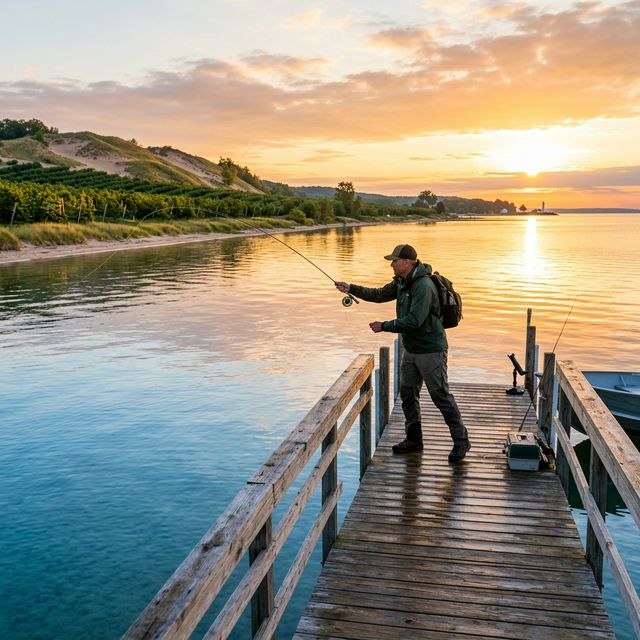
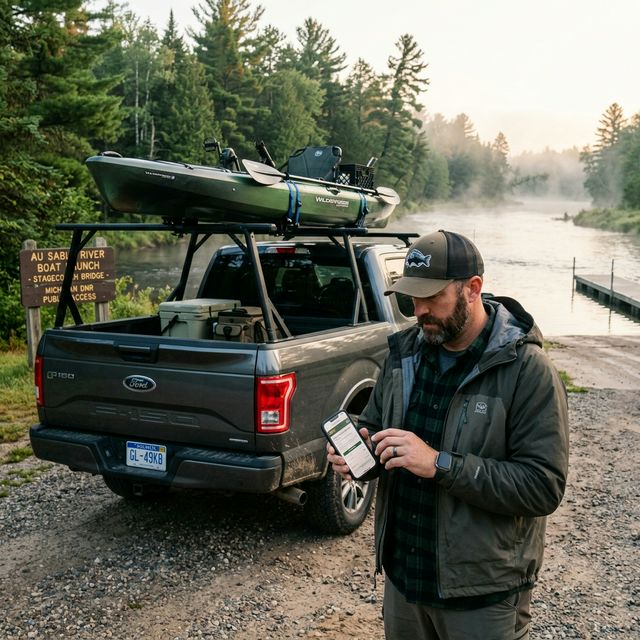
Your GPS says 45 minutes to the Au Sable River launch, but you’ve been watching the odometer since you crossed the Ohio-Michigan line on US-23 two hours ago. The landscape has been shifting — flat corn stubble giving way to rolling hills, then pine forest so thick it blocks the pre-dawn sky. Your buddy, riding shotgun with a tackle bag between his feet, is scrolling his phone. “It says Michigan licenses cover everything — lakes, rivers, Great Lakes. One license.” He sounds skeptical. He’s from Pennsylvania, where you need a fishing license, a trout stamp, a Lake Erie permit, and a separate combo for the lake boats. “One license,” you confirm. “Seventy-six bucks. Every species, every water in the state.”
This is Michigan’s greatest advantage for visiting anglers — and the thing that surprises almost everyone coming from states with fragmented licensing systems. One license. All species. All waters. No trout stamp. No Great Lakes endorsement. No saltwater add-on. The $76 annual non-resident license or the $10 daily license gets you legal access to 11,000 inland lakes, 36,000 miles of rivers and streams, and 3,288 miles of Great Lakes coastline. That simplicity is rare, and it changes how you plan a trip.
Michigan’s All-Species, All-Waters License System
Unlike states that split freshwater and saltwater, or require separate trout stamps and Great Lakes endorsements, Michigan operates the cleanest licensing structure in the Great Lakes region. Every fishing license — resident or non-resident — covers:
- All five Great Lakes bordering Michigan (Superior, Michigan, Huron, Erie, and the connecting Lake St. Clair)
- All inland lakes — from massive Houghton Lake (20,075 acres) to remote Upper Peninsula pothole lakes
- All rivers and streams — including legendary trout water like the Au Sable, Pere Marquette, and Manistee
- All species — bass, walleye, trout, salmon, pike, panfish, sturgeon, muskie — everything
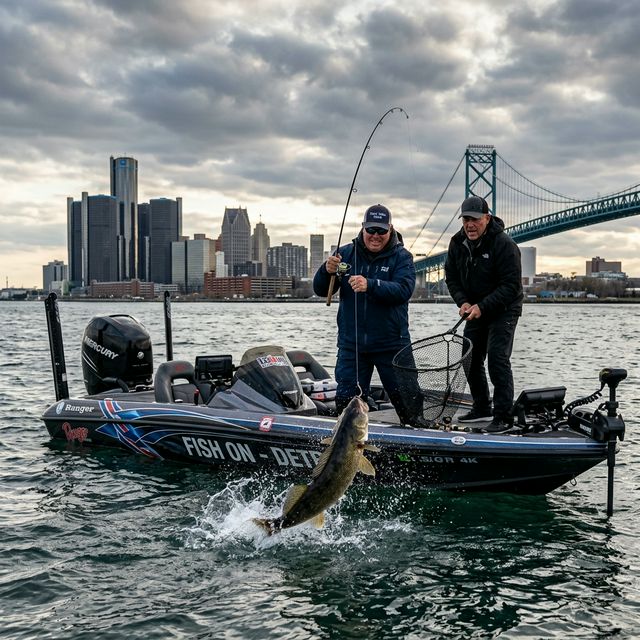
What this means practically: You can fish the Au Sable River for brown trout on Monday, troll for king salmon on Lake Michigan on Wednesday, chase walleye on Saginaw Bay Thursday, and target smallmouth bass on the Detroit River Saturday — all on one $76 license. No add-ons, no endorsements, no stamps.
Non-Resident License Types and Prices (2026)
| License Type | Duration | Base Price | Surcharge | Total |
|---|---|---|---|---|
| Annual All-Species (Non-Resident) | April 1 – March 31 next year | $76.00 | $1.00 | $77.00 |
| 24-Hour All-Species (Anyone) | 24 hours from selected start | $10.00 | — | $10.00 |
All annual license prices are subject to a $1 surcharge dedicated to public education about hunting, fishing, and trapping. The surcharge is collected as a separate line item at purchase.
The Break-Even Math
The annual license costs $77 total (including surcharge) and the daily costs $10. Simple division: if you’ll fish 8 or more days in Michigan this year, the annual license saves money. For anglers making a single long weekend trip (3-4 days), the daily license at $30-$40 total is the better deal. But if you’re planning the classic Michigan two-trip year — spring steelhead run plus fall salmon run — the annual license pays for itself the moment you start trip two.
What You’ll Actually Pay: Common Visitor Scenarios
| Your Plan | License Needed | Total Cost |
|---|---|---|
| 3-day walleye trip to Saginaw Bay | Three 24-Hour licenses | $30.00 |
| Week-long Au Sable trout trip | Annual All-Species | $76.00 |
| Weekend bass tournament at St. Clair | Two 24-Hour licenses | $20.00 |
| Two trips: spring steelhead + fall salmon | Annual All-Species | $76.00 |
| One-day charter for Lake Michigan salmon | One 24-Hour license | $10.00 |
| Full-season Great Lakes + inland combo | Annual All-Species | $76.00 |
The charter boat note: Unlike some coastal states where charter boat licenses cover passengers, Michigan requires every angler 17+ on a charter to have their own individual fishing license. Most charter captains can help you purchase online before departure, but don’t assume you’re covered.

Piscifun Fishing Tackle Backpack
Large capacity fishing backpack with tackle boxes. Waterproof rain cover included.
Affiliate link · Prices may vary
How to Buy Your Non-Resident License
Online (Recommended — Available 24/7)
- Go to Michigan.gov/DNRLicenses
- Create an account or log in (name, date of birth, mailing address, SSN)
- Select “Fishing License” → “Non-Resident Annual” or “24-Hour”
- For 24-hour licenses, select your preferred start date and time
- Pay with credit or debit card
- Your license is valid immediately — save it on your phone or screenshot it
Michigan DNR Hunt Fish App
Download the free app (iOS and Android) for the most convenient option:
- Purchase and store your license digitally
- Set up auto-renewal so your license renews automatically each March
- Access fishing regulations, maps, and species information offline
- Report fish harvests directly from the water
In-Person Retailers (1,700+ Locations)
Michigan has the densest network of license retailers in the Great Lakes region:
- Meijer — most Michigan locations (24-hour stores = 24-hour license purchases)
- Walmart — sporting goods counter
- Jay’s Sporting Goods — Clare, MI (legendary tackle selection near Au Sable country)
- Cabela’s/Bass Pro Shops — Dundee, Grandville
- Local bait and tackle shops — virtually every town near fishable water
Critical tip for daily licenses: When purchasing a 24-hour license online, you can set the start date and time in advance. If your charter departs at 5 AM Tuesday, buy your 24-hour license Monday night and set the start time for 4:30 AM Tuesday. This avoids fumbling with your phone on a pitching boat at O-dark-thirty.
Michigan’s Top Non-Resident Fishing Destinations
The Great Lakes — Five Inland Seas
Michigan is the only state bordered by four of the five Great Lakes, plus Lake St. Clair. Each lake offers dramatically different fishing:
Lake Michigan (West Coast)
- King salmon: Trophy chinook from July through September, with Ludington, Manistee, and Frankfort producing fish over 30 pounds
- Steelhead: Spring runs (March–May) on tributary rivers; fall runs (September–November) draw fly anglers worldwide
- Brown trout: Nearshore trolling from March through June, particularly off Saugatuck and South Haven
- Smallmouth bass: World-class rock bass fishing along the northern shoreline near Petoskey and Charlevoix
Lake Erie (Southeast Corner)
- Walleye capital of the world: The Western Basin and Michigan’s Monroe-to-Bolles Harbor corridor produce massive spring and fall walleye runs
- Perch: Yellow perch fishing in the fall is legendary — 50-fish limits on good days
- Daily limit: 6 walleye per person, 15-inch minimum size
Lake Huron (East Coast)
- Saginaw Bay: The walleye factory — this shallow, nutrient-rich bay is Michigan’s most productive walleye fishery, with annual tournaments drawing thousands
- Thunder Bay: Brown trout trophy water near Alpena
- Les Cheneaux Islands: 36 islands creating a labyrinth of smallmouth bass habitat
Lake Superior (Upper Peninsula)
- Brook trout: Native coaster brook trout along the shoreline — unique fishery found nowhere else in the Lower 48
- Lake trout: Deep-water lakers from Marquette to Munising
- Wilderness experience: Less fishing pressure than any other Great Lake
Lake St. Clair and Connecting Waters
- Smallmouth bass: Routinely ranked the #1 smallmouth bass lake in North America
- Muskie: Trophy muskellunge fishery — 50-inch fish are caught annually
- Note: Bass possession season on Lake St. Clair, the St. Clair River, and the Detroit River doesn’t open until June 20, 2026 — nearly four weeks later than the statewide opener of May 23
Inland Waters — 11,000 Lakes and 36,000 Miles of Rivers
Au Sable River — The birthplace of American fly fishing. The Holy Water stretch between Grayling and Mio is regulated as flies-only, no-kill water for trophy brown trout. Non-residents should know: weekend summer canoeing traffic on the mainstream section is intense. Fish early mornings or the evening hatch for solitude.
Pere Marquette River — One of the best steelhead rivers east of the Rockies. Spring runs of chrome steelhead from March through May draw drift boat anglers from across the Midwest. Fall salmon runs (September–October) are equally spectacular.
Houghton Lake — Michigan’s largest inland lake (20,075 acres) and the state’s premier walleye and pike fishery. The winter ice fishing season here is legendary — Tip-Up Town USA, the largest ice fishing festival in the country, draws 10,000+ anglers each January.

Plano Guide Series Rod Tube Case
Hard-shell rod tube protects rods during travel. Airline-approved for checked baggage.
As an Amazon Associate, we earn from qualifying purchases. Prices may vary.
Border Water Rules: Great Lakes Complexity
Michigan shares water with four states (Ohio, Indiana, Wisconsin, Minnesota) and one Canadian province (Ontario). The border rules are more complex than any inland state:
Lake Erie (Michigan-Ohio)
- A valid Michigan or Ohio license covers the open waters of Lake Erie
- Tributaries follow geography: Maumee River (Ohio) requires an Ohio license; River Raisin (Michigan) requires a Michigan license
- Bag limits may differ: Michigan and Ohio sometimes set different walleye limits for Lake Erie. When fishing the shared open water, follow the regulations of the state your license is from
- The line: The interstate boundary runs roughly east-west through the middle of the western basin
Lake Michigan (Michigan-Wisconsin-Indiana)
- Michigan’s license covers Michigan waters of Lake Michigan
- The Michigan-Wisconsin boundary runs roughly north-south through the middle of the lake
- Indiana: The short Indiana shoreline near Michigan City requires an Indiana license for Indiana waters; Michigan license covers Michigan waters
- Salmon and trout trolling often crosses state boundaries — know where the line is, especially during tournament fishing
Lake Superior/Lake Huron (Michigan-Wisconsin-Minnesota-Ontario)
- Michigan license covers Michigan waters only
- Fishing in Canadian waters of the Great Lakes requires an Ontario fishing license — purchased separately from the Ontario Ministry of Natural Resources
- The Sault Ste. Marie rapids area between Lake Superior and Lake Huron has particularly complex jurisdictional boundaries
The practical rule: If you stay in Michigan waters and hold a Michigan license, you’re always legal. The complexity arises only when you cross state or international boundaries on the Great Lakes. GPS-equipped charter captains know the lines; if you’re on your own, download the Michigan DNR Hunt Fish app, which shows jurisdictional boundaries.
Cost Comparison: Michigan vs. Great Lakes Neighbors
| State | Annual NR License | Daily License | Trout/Salmon Add-On | Total (All-Access) |
|---|---|---|---|---|
| Michigan | $76 (+$1 surcharge) | $10.00 | Included | $77.00 |
| Wisconsin | $65.00 | $10.00 | $10.00 (inland trout stamp) | $75.00 |
| Minnesota | $55.00 | $12.00 | $13.00 (trout stamp) | $68.00 |
| Ohio | $50.00 | N/A | Included | $50.00 |
| Indiana | $35.00 | N/A | $13.00 (trout/salmon) | $48.00 |
| Illinois | $31.50 | N/A | $6.50 (inland trout) | $38.00 |
Why Michigan costs more — and why it’s worth it: Michigan’s $77 annual (including surcharge) is the highest base price in the Great Lakes region. But it includes everything — trout, salmon, Great Lakes, inland — with zero add-ons. Wisconsin’s $65 looks cheaper until you add the $10 inland trout stamp ($75 total). Ohio’s $50 appears to be a bargain, but Ohio has only one Great Lake (Erie), while Michigan borders four. Michigan’s true value is in the scope of water you access — 3,288 miles of Great Lakes shoreline, 11,000 inland lakes, and 36,000 miles of rivers, all on a single license.
Multi-State Trip Strategy
The classic Great Lakes road trip hits Michigan, Wisconsin, and Minnesota in one swing. Here’s what it costs:
| Trip | Licenses Needed | Total Cost | Best Season |
|---|---|---|---|
| Michigan + Wisconsin (salmon trolling) | MI annual ($77) + WI annual ($65) + WI trout stamp ($10) | $152.00 | July–September |
| Michigan + Ohio (walleye circuit) | MI annual ($77) + OH annual ($50) | $127.00 | April–June |
| Michigan only — full season | MI annual ($77) | $77.00 | April–March |

KastKing Blackhawk II Telescoping Rod
Portable telescoping design collapses to 17 inches. Perfect for travel fishing.
Affiliate link · Prices may vary
Exemptions: Who Fishes Free in Michigan
| Category | License Required? | Notes |
|---|---|---|
| Anglers under 17 (any state) | ❌ Free | No license needed; voluntary $2 youth license available |
| Free Fishing Weekends (Feb 14-15, June 13-14) | ❌ Free for everyone | All regulations still apply; Recreation Passport also waived |
| 100% Disabled Veterans (MI residents) | ❌ Free | Must present VA documentation; residents only |
| Legally Blind (MI residents) | ❌ Free | Senior-rate license ($11) covers all species |
| Non-resident seniors 65+ | ✅ Full NR price ($76) | No senior discount for non-residents |
| Non-resident disabled veterans | ✅ Full NR price ($76) | Veteran benefits are MI-residents only |
For age-related details, see the Michigan age requirements guide. For resident veteran benefits, see the veterans & disabled guide.
Penalties for Fishing Without a License
Michigan Conservation Officers patrol both inland waters and the Great Lakes. DNR enforcement is particularly active during:
- Opening weekend of walleye season (late April)
- Salmon season on Lake Michigan tributaries (September–October)
- Ice fishing season on popular lakes (January–March)
| Violation | Potential Penalty |
|---|---|
| Fishing without any license | Up to $500 fine + court costs |
| Exceeding bag or size limits | Up to $500 fine per violation + rod/reel/boat confiscation possible |
| Fishing during closed season | Up to $1,000 fine + potential license revocation |
| Taking sturgeon without proper license | Up to $2,500 fine (sturgeon are heavily protected) |
Enforcement reality: Michigan Conservation Officers can check your license at any time on the water, at boat launches, on shore, and even at fish cleaning stations. Having your license on the DNR Hunt Fish app is the fastest way to show proof. Officers can also verify your status by name and date of birth through their system.
Five Mistakes Non-Residents Make in Michigan
Assuming Great Lakes fishing requires a separate license — It doesn’t. Michigan’s all-species license covers everything from a brook trout stream in the Upper Peninsula to a salmon charter on Lake Michigan. Don’t double-pay for something you already have.
Missing the Lake St. Clair bass delay — Bass possession season opens statewide on the third Saturday of May (May 23, 2026), but Lake St. Clair, the St. Clair River, and the Detroit River don’t open for bass possession until the third Saturday of June (June 20, 2026). Catch-and-immediate-release is open year-round, but if you’re planning a spring tournament, verify the specific water’s season date.
Not checking county-specific regulations — Michigan’s fishing regulations vary significantly by county and sometimes by individual lake. The statewide rules are the baseline, but many lakes and rivers have special regulations. Always check the “Exceptions by County” section on the DNR website or app before fishing unfamiliar water.
Underestimating the Upper Peninsula — Most non-residents fish the Lower Peninsula because it’s closer to major population centers. But the UP has half the state’s total area, a fraction of the fishing pressure, and wilderness-quality brook trout, walleye, and pike fishing. If you’re willing to drive the extra 3-4 hours, you’ll fish waters that feel like Canada — because they practically are.
Ignoring the license calendar — Michigan’s license year runs April 1 through March 31 of the following year — a full 12-month window. If you’re buying in late March for an April trip, buy the new year’s license (valid April 1 forward), not the expiring one. The DNR website will show both options during the overlap period in March.
Source: Michigan Department of Natural Resources, verified March 2026. Prices reflect 2025–2026 license year (April 1, 2025 – March 31, 2026). Annual licenses subject to $1 surcharge for public education on hunting, fishing, and trapping.