 FishKillFlea
The alarm on the charter captain’s phone is set for 4:15 AM, but the captain — a third-generation waterman from Tilghman Island — has been awake since 3:30, watching the radar on his nav screen. The wind forecast reads “SW 5-10, bay chop 1 foot.” Perfect rockfish conditions. By 5:00 AM, six clients are standing on the dock at Harrison’s Chesapeake House, clutching coffee cups and tackle bags, ready for a spring trophy striper run. One of them — a first-timer from Pittsburgh — holds up his phone and asks: “I bought the fishing license online. Is that the right one?” The captain looks. It’s a nontidal sport fishing license. It covers everything in Maryland except the 200 miles of Chesapeake Bay they’re about to spend 8 hours on.
Maryland’s tidal fishing system revolves around the Chesapeake Bay and Coastal Sport Fishing License — a separate license from the freshwater (nontidal) license that covers the largest estuary in North America plus the Atlantic Ocean coastline. At $15 for residents and $22.50 for non-residents, it’s one of the best saltwater bargains on the Eastern Seaboard. But its relationship to the nontidal license, the charter boat exemption, and the Saltwater Angler Registration creates a web of rules that trips up visiting anglers.
The Chesapeake Bay License: What It Covers
Geographic Coverage
The Chesapeake Bay and Coastal Sport Fishing License covers:
- The entire Chesapeake Bay — from the Susquehanna Flats to the Virginia line
- All tidal tributaries — the Potomac (below Great Falls), Patuxent, Choptank, Chester, Nanticoke, and every tidal creek feeding the Bay
- Atlantic Ocean — Maryland’s state waters from Ocean City to the 3-mile federal boundary
- Coastal bays — Assawoman Bay, Isle of Wight Bay, Sinepuxent Bay, Chincoteague Bay
- Tidal Potomac River — Below Great Falls (reciprocal agreement with Virginia means VA license holders can also fish the main stem Potomac)
What It Does NOT Cover
- Nontidal freshwater waters — Deep Creek Lake, Liberty Reservoir, Loch Raven, Prettyboy Reservoir, mountain streams
- Federal waters — Beyond 3 nautical miles offshore (no state license needed, but federal regulations apply)
- Trout waters — The Trout Stamp is a separate add-on purchased with the nontidal license, not the Bay license
Saltwater License Options and Prices (2026)
Resident
| License | Duration | Price |
|---|---|---|
| Annual Bay & Coastal | 365 days from purchase | $15.00 |
| 7-Day Bay & Coastal | 7 consecutive days | $6.00 |
| Senior Consolidated (65+) | 365 days | $12.00 (includes both nontidal + tidal) |
Non-Resident
| License | Duration | Price |
|---|---|---|
| Annual Bay & Coastal | 365 days from purchase | $22.50 |
| 7-Day Bay & Coastal | 7 consecutive days | $12.00 |
Price context: Maryland’s $22.50 non-resident annual saltwater license is among the cheapest on the Atlantic coast. For comparison: Florida charges $47 for non-resident saltwater, South Carolina charges $35, and North Carolina charges $30. Only a handful of states (like New Jersey’s free saltwater registry) are cheaper.

Yo-Zuri Crystal 3D Minnow
Holographic finish attracts fish. Great for inshore saltwater species.
Affiliate link · Prices may vary
Charter Boat and Headboat Rules
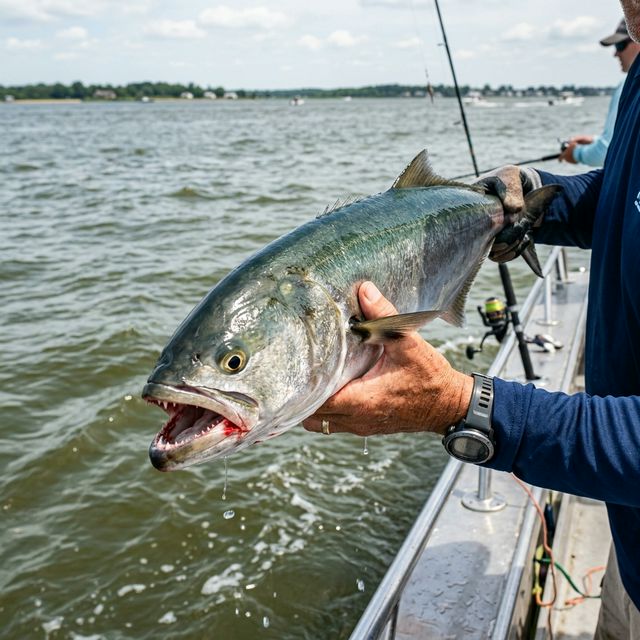
Maryland’s charter boat system uses a boat-level license that replaces individual passenger licenses:
How It Works
- The charter/headboat operator purchases a Chesapeake Bay and Coastal Sport Boat License ($50/year resident, $100/year non-resident)
- Individual passengers on a licensed boat do not need their own Bay & Coastal license
- Instead, passengers aged 16+ must hold a free Maryland Saltwater Angler Registration
- The registration fulfills both the state and federal (NOAA) catch data requirements — by registering with Maryland, you don’t need to register separately with NOAA
Getting Your Saltwater Angler Registration
- Go to compass.dnr.maryland.gov
- Create or log in to your COMPASS account
- Select “Saltwater Angler Registration” (free — no cost)
- Complete the registration — save or print the confirmation
- Carry it on charter trips — the registration is valid until you cancel it
What This Means Practically
| Scenario | What You Need |
|---|---|
| Charter boat trip out of Kent Narrows | Free Saltwater Angler Registration (captain’s boat license covers you) |
| Headboat out of Ocean City | Free Saltwater Angler Registration |
| Your own boat on the Chesapeake Bay | Bay & Coastal Sport Fishing License ($15 resident) |
| Kayak fishing in the Bay | Bay & Coastal Sport Fishing License |
| Shore fishing at Sandy Point State Park | Bay & Coastal Sport Fishing License |
| Pier fishing at Ocean City (public pier) | Bay & Coastal Sport Fishing License |
| Fishing from a friend’s private boat (no sport boat license) | Bay & Coastal Sport Fishing License |
Confirm with your charter captain: Some charter operations register their clients automatically as part of the booking process. Others expect you to bring your own Saltwater Angler Registration. Call ahead before your trip to avoid a dock-side scramble.
The Tidal/Nontidal Boundary: Where Freshwater Becomes Saltwater
This is the dividing line that determines which license you need. Some key boundaries:
| Waterway | Tidal Boundary (Approximate) | Above = Nontidal License | Below = Bay License |
|---|---|---|---|
| Susquehanna River | Conowingo Dam | ✅ | ✅ |
| Potomac River | Great Falls | ✅ | ✅ |
| Patapsco River | Elkridge area | ✅ | ✅ |
| Gunpowder Falls | Upstream of tidal influence (at Loch Raven) | ✅ | ✅ |
| Patuxent River | Above tidal reach (varies by section) | ✅ | ✅ |
| Northeast River | Above Charlestown | ✅ | ✅ |
The Gray Zone
Some waters have tidal influence that isn’t obvious — particularly the lower reaches of Bay tributaries where brackish water extends upstream. If you’re fishing a creek that feeds into the Chesapeake Bay and you’re not sure whether it’s tidal or nontidal:
- Check the DNR tidal boundary maps on the Maryland fisheries website
- Look for physical indicators: tidal fluctuation at the banks, brackish water color, Bay species like white perch or striped bass
- Call DNR at (410) 260-8300 to ask about your specific location
- When in doubt, carry both licenses — the Bay license is only $15 for residents, and having both eliminates any risk of an expensive mistake

Penn Battle III Surf Spinning Combo
10-foot surf rod with Penn Battle III reel. Built for beach casting stripers and bluefish.
As an Amazon Associate, we earn from qualifying purchases. Prices may vary.
Chesapeake Bay Fishing Zones
The Bay is divided into management zones that affect regulations for certain species:
Upper Bay (Above Bay Bridge)
- Key species: Striped bass (spring spawning run), white perch, blue catfish, yellow perch
- Notable areas: Susquehanna Flats, Northeast River, Elk River, Pooles Island
- Character: Brackish water with strong freshwater influence; exceptional spring fishing when stripers stage for spawning runs up the tributaries
Mid-Bay (Bay Bridge to Solomons)
- Key species: Striped bass (year-round), bluefish, spot, white perch, blue crabs
- Notable areas: Kent Narrows, Eastern Bay, Choptank River, Tangier Sound, Poplar Island
- Character: Classic Chesapeake ecology with the broadest species diversity; the best all-around fishing zone
Lower Bay (Solomons to Virginia Line)
- Key species: Red drum, summer flounder, croaker, spot, bluefish, cobia (seasonal)
- Notable areas: Point Lookout, Smith Island, Bloodsworth Island, Hooper Island
- Character: Higher salinity, more ocean-influenced species mix; excellent fall fishing when southern species push north
Coastal Bays and Ocean (Ocean City Area)
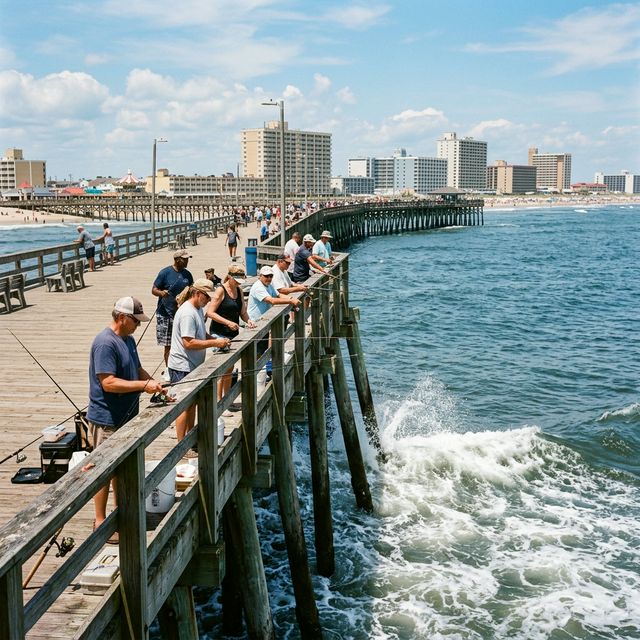
- Key species: Summer flounder, black sea bass, tautog, bluefish, spot, croaker, red drum, offshore billfish and tuna (federal waters)
- Notable areas: Ocean City Inlet, Assawoman Bay, Route 50 bridge pilings, Isle of Wight shoal, artificial reef sites (Great Eastern, Bass Grounds)
- Character: Ocean fishery with distinct species and seasons from the Bay; the only Maryland port for offshore canyon trips
Key Saltwater Species Regulations (2026)
Chesapeake Bay Striped Bass (Rockfish)
The Bay’s signature species — see the rules and regulations guide for complete details:
| Season | Bag Limit | Slot Limit |
|---|---|---|
| January 1 – April 30 | Catch and release only | N/A |
| May 1 – July 31 | 1/person/day | 19-24 inches |
| August | CLOSED — no targeting | N/A |
| September 1 – December 5 | 1/person/day | 19-24 inches |
| December 6 – December 31 | Catch and release only | N/A |
Other Tidal Species Quick Reference
| Species | Min. Size | Daily Limit | Season |
|---|---|---|---|
| White Perch | None | 25 | Year-round |
| Blue Catfish | None | No limit (invasive — harvest encouraged) | Year-round |
| Snakehead | None | No limit (invasive — must kill if caught) | Year-round |
| Bluefish | 8 inches | 5 (private) / 7 (for-hire) | Year-round |
| Summer Flounder | 16” (Jan-May), 17.5” (Jun-Dec) | 4 | Year-round |
| Red Drum | 18-27 inch slot | 1 | Year-round |
| Spot | None | No limit | Year-round |
| Croaker | 9 inches | 25 | Year-round |
| Yellow Perch (tidal) | 8 inches (varies by area) | 5 (2026 reduction) | Year-round |
| Weakfish | 13 inches | 1 | Year-round |
| Tautog (Blackfish) | 16 inches | 4 | Open season varies |
| Black Sea Bass | 13 inches | 2 (check current limits) | Seasonal |
Summer flounder 2026 change: For the first time, Maryland has opened summer flounder fishing year-round with split size limits — 16 inches minimum from January through May, then 17.5 inches from June through December. The 4-fish daily bag limit applies year-round.

Penn Battle III Spinning Reel
Full metal body and sideplate. HT-100 carbon fiber drag washers for smooth performance.
Affiliate link · Prices may vary
Federal vs. State Waters
Maryland’s saltwater jurisdiction extends 3 nautical miles from shore:
| Zone | License Needed | Regulations |
|---|---|---|
| 0-3 nautical miles (state waters) | Maryland Bay & Coastal license | Maryland DNR rules apply |
| 3+ nautical miles (federal EEZ) | No state license | Federal NMFS regulations apply |
| HMS species (tuna, sharks, billfish) | Federal HMS permit required | Regardless of location |
Practical Impact for Ocean City Anglers
- Inshore fishing (bay, inlet, near-shore ocean within 3 miles): Maryland Bay & Coastal license, Maryland regulations
- Offshore charter (canyon trips for tuna, billfish, mahi-mahi): No Maryland license needed in federal waters, but the captain needs a federal HMS charter permit. Passengers may need individual HMS permits for certain species
- Bottom fishing (sea bass, tautog on reef sites): If within 3 miles, Maryland license needed; if beyond 3 miles, federal rules only — size limits and seasons may differ
- HMS reporting: Effective December 22, 2025, anglers with HMS permits must report recreationally landed bluefin tuna, billfishes, and swordfish electronically within 24 hours
Blue Crab Fishing (Recreational Crabbing)
Maryland’s Chesapeake Bay is as famous for its blue crabs as for its rockfish. Recreational crabbing has its own licensing structure — separate from your fishing license:
When You Don’t Need a Crabbing License
You can crab without any license using only handlines and dip nets (from docks, piers, bridges, boats, or shorelines):
| Gear | License Required? | Daily Limit |
|---|---|---|
| Handlines + dip nets only | ❌ No | 2 dozen male hard crabs + 1 dozen soft/male peelers |
| Waterfront property crab pots (registered, max 2) | ❌ No (free annual registration) | 2 dozen male hard crabs + 1 dozen soft/male peelers |
When You Need a Crabbing License
| Gear | License Required? | License Cost |
|---|---|---|
| Collapsible crab traps (up to 10 per person) | ✅ Yes | $5 resident / $10 non-resident |
| Net rings | ✅ Yes | $5 / $10 |
| Trotlines | ✅ Yes | $5 / $10 |
| Any gear if exceeding unlicensed daily limits | ✅ Yes | $5 / $10 |
Discount: If you hold a resident Bay & Coastal Sport Fishing License or Senior Consolidated license, the recreational crabbing license is only $2.00 instead of $5.
Licensed Crabber Daily Limits
With a recreational crabbing license, your limits increase:
| Category | Licensed Limit |
|---|---|
| Male hard crabs | 1 bushel or 6 dozen (container other than bushel basket) |
| Male peelers / soft crabs | 2 dozen |
Key Crabbing Rules
- Season: April 1 – December 15 in the Chesapeake Bay and tidal tributaries
- Female crabs: Illegal to keep any female hard or peeler crabs — recreational crabbers may only keep males
- Egg-bearing (sponge) crabs: Illegal to possess under any circumstances
- Size limits: Males must be at least 5 inches (Apr 1 – Jul 14) or 5¼ inches (Jul 15 – Dec 15), measured spike-to-spike
- No crabbing on Wednesdays in most areas (with limited holiday exceptions)
- Time restrictions: Generally from half-hour after sunrise to sunset (April, Oct-Dec) or half-hour before sunrise to sunset (May-Sep); mainstem Bay closes at 5 PM
- Turtle excluder devices: Required in all recreational crab pots — rectangular openings no larger than 1¾” × 4¾” at each entrance to prevent terrapin drowning
- No selling: Recreational crabbers may not sell their catch under any circumstances
Coastal Bays Exception
Crabbing in the Atlantic Ocean, coastal bays (Ocean City area), and their tributaries does not require a recreational crabbing license. Standard gear limits still apply.
Chesapeake Bay Charter Ports
Maryland’s major charter fishing ports, each with a distinct character and seasonal peak:
| Port | Best For | Peak Season | Notes |
|---|---|---|---|
| Tilghman Island | Trophy rockfish, bluefish | May-November | Classic waterman community, legendary light-tackle guides |
| Kent Narrows | Rockfish, perch, crabbing | April-November | Easy Bay Bridge access from Baltimore/Washington |
| Chesapeake Beach | Rockfish, bottom fish | April-October | Rod & Reel Resort is the hub, family-friendly options |
| Solomons Island | Rockfish, bluefish, drum | May-November | Southern Bay access, exceptional fall trophy season |
| Ocean City | Flounder, sea bass, offshore pelagics | May-October | Maryland’s only ocean port, canyon trips for white marlin |
| Havre de Grace | Upper Bay rockfish, catfish | April-October | Susquehanna Flats spring run headquarters |
| Rock Hall | Rockfish, perch | April-November | Eastern Shore charm, mid-Bay access, smaller operations |
Charter Captain Selection Tips
- Verify the Sport Boat License: Ask if the vessel holds a current Chesapeake Bay and Coastal Sport Boat License — this is what exempts passengers from needing individual Bay licenses
- Ask about Saltwater Angler Registration: Does the captain handle this at booking, or do you need to register yourself beforehand?
- Half-day vs. full-day: Most Bay charters offer 4-hour AM trips (5 AM – 9 AM) and PM trips (1 PM – 5 PM) or full-day trips (5 AM – 1 PM). Ocean City offshore runs are typically full-day only
- Shared vs. private charter: Headboats (shared party boats) are the budget option at $50-75/person; private charters run $500-1,000+ for up to 6 passengers
The Dual-License Decision: Do You Need Both?
Many visiting anglers struggle with whether to buy both the nontidal and Bay licenses. Use this decision framework:
| Where You’re Fishing | Which License(s) |
|---|---|
| Only Chesapeake Bay / Ocean City | Bay & Coastal only ($15 resident / $22.50 NR) |
| Only freshwater lakes and streams | Nontidal only ($32 resident / $55 NR) |
| Both fresh and salt (most versatile) | Both licenses ($47 resident / $77.50 NR) |
| Plus trout streams | Both + Trout Stamp ($67 resident / $107.50 NR) |
| Senior 65+ (covers everything except trout) | Senior Consolidated ($12) — replaces both individual licenses |
For complete license pricing and purchasing details, see the non-resident guide or senior guide.
Source: Maryland Department of Natural Resources, verified March 2026. Crabbing regulations from 2026 Maryland Guide to Fishing and Crabbing. Charter boat regulations subject to USCG and federal requirements.