 FishKillFlea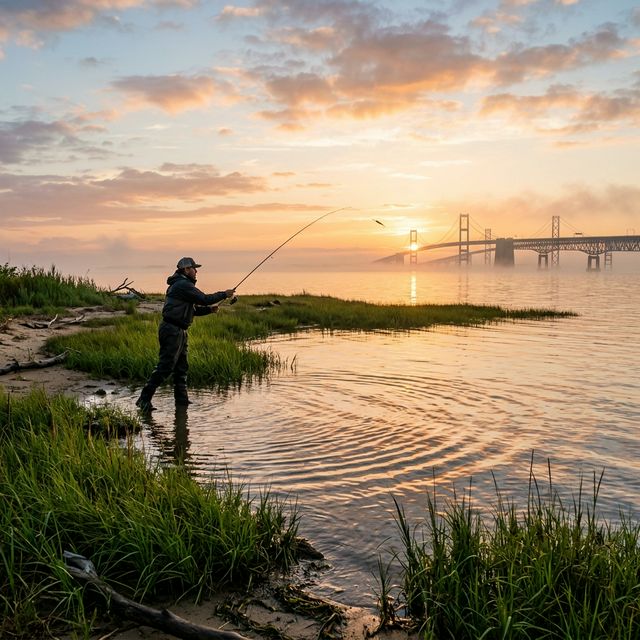
You’re idling at the Route 50 bridge tollbooth in the pre-dawn dark, watching the Chesapeake Bay Bridge materialize in amber sodium light above you. The car smells like cut shad and coffee. Your buddy, who drove down from Philadelphia at 2 AM, is reading something on his phone in the passenger seat and suddenly looks confused. “It says I need a ‘Chesapeake Bay and Coastal Sport Fishing License.’ I already bought a fishing license online last night.” You glance over. He bought the nontidal license — the freshwater one. It covers Deep Creek Lake in the mountains, 180 miles west. It does not cover the 4,479 square miles of the Chesapeake Bay you’re headed to right now.
This is the single most common mistake non-residents make in Maryland — and it flows directly from something that makes Maryland unusual among East Coast states: the freshwater and saltwater licensing systems are completely separate. Two different licenses. Two different agencies within DNR. Two different sets of rules. Understanding this split is the first thing every visiting angler needs to know.
Maryland’s Dual License System: Nontidal vs. Chesapeake Bay
Unlike most states where a single fishing license covers all waters, Maryland draws a bright line between:
- Nontidal (freshwater) — rivers, streams, lakes, and ponds above the tidal influence line
- Chesapeake Bay and Coastal (saltwater) — the Bay, its tidal tributaries, Atlantic coastal bays, and the ocean
This isn’t just a naming convention. The two systems have different prices, different durations, different regulations, and — critically — one does not include the other. If you plan to fish Deep Creek Lake on Saturday and charter a rockfish trip out of Kent Narrows on Monday, you need both licenses.
Where Exactly Is the Line?
The tidal/nontidal boundary is defined by the Maryland DNR for each waterway. Key boundaries that trip up visiting anglers:
| Waterway | Tidal Boundary | Above = Nontidal | Below = Bay License |
|---|---|---|---|
| Susquehanna River | Conowingo Dam | ✅ | ✅ |
| Potomac River | Great Falls | ✅ | ✅ |
| Patapsco River | Elkridge area | ✅ | ✅ |
| Gunpowder Falls | Above tidal influence | ✅ | ✅ |
| Patuxent River | Varies upstream | ✅ | ✅ |
When in doubt: If you’re fishing a creek that feeds into the Bay and you’re unsure whether it’s tidal or nontidal, carry both licenses. The Bay license is only $22.50 for non-residents annually — cheap insurance against a citation. You can also call DNR at (410) 260-8300 for specific boundary clarification.
Non-Resident License Types and Prices (2026)
Nontidal (Freshwater) Licenses
| License Type | Duration | Price | Per-Day Cost |
|---|---|---|---|
| Annual Nontidal | 365 days from purchase | $55.00 | $0.15 |
| 7-Day Nontidal | 7 consecutive days | $45.00 | $6.43 |
| 3-Day Nontidal | 3 consecutive days | $35.00 | $11.67 |
Chesapeake Bay and Coastal (Saltwater) Licenses
| License Type | Duration | Price | Per-Day Cost |
|---|---|---|---|
| Annual Bay & Coastal | 365 days from purchase | $22.50 | $0.06 |
| 7-Day Bay & Coastal | 7 consecutive days | $12.00 | $1.71 |
Add-On Stamps and Registrations
| Stamp | Price | Who Needs It |
|---|---|---|
| Non-Resident Trout Stamp | $30.00 | Anyone fishing in designated nontidal trout waters |
| Saltwater Angler Registration | Free | Required when fishing from a licensed charter/headboat instead of a personal Bay license |
What You’ll Actually Pay: Common Visitor Scenarios
Maryland’s split system creates several distinct price points. Here’s what real trips cost:
| Your Plan | Licenses Needed | Total Cost |
|---|---|---|
| Weekend bass fishing at Deep Creek Lake | 3-Day Nontidal | $35.00 |
| Week-long Chesapeake Bay rockfish trip | 7-Day Bay & Coastal | $12.00 |
| Charter trip out of Kent Narrows (half day) | Free Saltwater Angler Registration | $0.00 |
| Week-long Deep Creek + Bay combination | 7-Day Nontidal + 7-Day Bay | $57.00 |
| Annual freshwater + saltwater | Annual Nontidal + Annual Bay | $77.50 |
| Annual everything including trout | Nontidal + Bay + Trout Stamp | $107.50 |
The $22.50 bargain: Maryland’s Chesapeake Bay annual license is one of the cheapest saltwater permits on the entire Atlantic coast. Florida charges $47 for non-resident saltwater; South Carolina charges $35; Virginia charges $25.00. Maryland’s $22.50 gets you 365 days on North America’s largest and most productive estuary. If you make even two Bay trips per year, the annual license pays for itself over the 7-day option.
The Reciprocal Fee System
Maryland has a unique provision: nontidal license fees are subject to reciprocal adjustments. If your home state charges Maryland residents more than $55 for a non-resident fishing license, Maryland will charge you the higher amount. This works both ways — it’s designed to maintain fee parity between states.
How this affects you: Most Mid-Atlantic and Southeastern states charge less than $55 for non-resident freshwater licenses, so the standard $55 rate applies. But if you’re from a state with expensive NR fees (some Western states charge $100+), check the current reciprocal schedule on COMPASS before purchasing.
The 7-day ($45.00) and 3-day ($35.00) licenses are also subject to reciprocal adjustments.

Piscifun Fishing Tackle Backpack
Large capacity fishing backpack with tackle boxes. Waterproof rain cover included.
Affiliate link · Prices may vary
How to Buy Your Non-Resident License
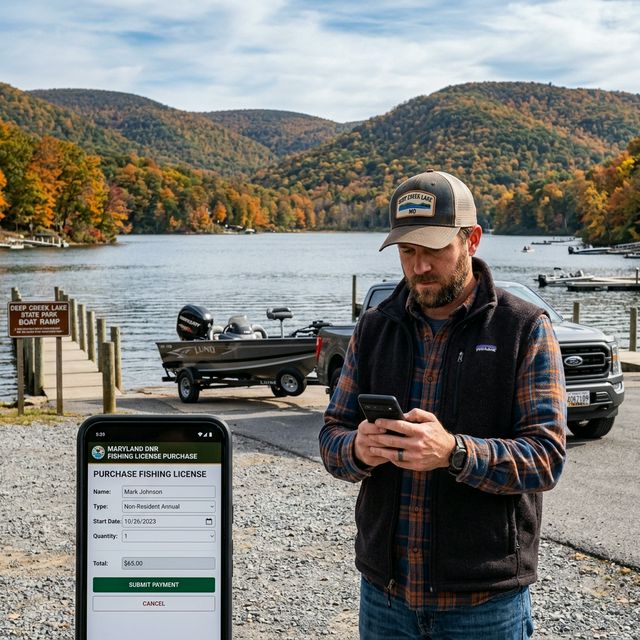
Online Through COMPASS (Recommended — Available 24/7)
- Go to compass.dnr.maryland.gov
- Create a COMPASS account (name, date of birth, mailing address, email)
- Select each license type you need — remember to add both nontidal and Bay if fishing both waters
- Add the Trout Stamp if you plan to fish designated trout waters
- Pay with credit or debit card
- Your confirmation receipt is your legally valid license immediately — screenshot it, save the email, or print it
Critical COMPASS tips for non-residents: The “Nontidal Sport Fishing” and “Chesapeake Bay and Coastal Sport Fishing” options look similar on the COMPASS website. Read the descriptions carefully. Also: each license starts its own 365-day clock on the date of purchase, so if you buy them on different days, they’ll expire on different dates.
In-Person Retailers
Licensed agents throughout Maryland sell fishing licenses. Bring photo ID:
- Walmart — Sporting goods counter (most Maryland locations)
- Bass Pro Shops — Arundel Mills, Hanover, MD
- Local bait and tackle shops — Anglers Sport Center (Annapolis), Clyde’s Sport Shop (Havre de Grace), Tochterman’s (Baltimore)
- Marinas — Many Bay-area marinas sell licenses at the dock
By Phone
Call the DNR Licensing Division at (410) 260-3220, Monday-Friday, 8:00 AM – 4:30 PM Eastern.
Maryland’s Top Non-Resident Fishing Destinations
The Chesapeake Bay — America’s Estuary
The 200-mile-long Chesapeake Bay is the defining feature of Maryland fishing. It’s the largest estuary in North America, and its fishery revolves around one species above all: striped bass (rockfish). Maryland’s rockfish fishery operates under some of the most carefully managed regulations on the Atlantic coast:
- 2026 harvest season: May 1 – July 31 and September 1 – December 5
- Slot limit: 19 to 24 inches — one fish per person per day
- Catch and release only: January 1 – April 30 and December 6 – December 31
- August: Completely closed to all striped bass fishing — no targeting, no catch and release
- Circle hooks mandatory: Non-offset circle hooks required when using natural bait (live or dead)
- Night restriction: No possession of striped bass between midnight and 5:00 AM
Beyond rockfish, the Bay produces world-class blue catfish fishing (invasive giants in the upper Bay tributaries — no daily limit), excellent white perch runs (spring through fall Bay-wide), summer runs of spot and croaker in the mid-to-lower Bay, and red drum in the lower Bay and coastal bays.
Deep Creek Lake — Garrett County’s Mountain Gem
At 3,900 acres and 2,500 feet elevation in far-western Maryland, Deep Creek Lake is the state’s largest freshwater body and its premier mountain fishery:
- Target species: Largemouth bass, smallmouth bass, walleye, yellow perch, northern pike, chain pickerel
- Special bass regulations: Largemouth and smallmouth bass have a 15-inch minimum size limit, with a protected 18–21 inch slot (fish in this range must be immediately released)
- Walleye regulations: 15-inch minimum, 18–21 inch protected slot, closed season March 1 – April 15
- Yellow perch: 5 fish daily limit (reduced for 2026 statewide)
- Non-resident draw: Clear mountain water, 69 miles of shoreline, and a completely different ecosystem than the Bay — elevation, species, and landscape feel like the Appalachian backcountry, not the coastal Mid-Atlantic
Ocean City — Atlantic Surf and Offshore
Maryland’s 31 miles of Atlantic coastline center on Ocean City, which offers a completely different fishery from the Bay:
- Surf fishing: Kingfish, spot, croaker, bluefish from the beach
- Pier fishing: Ocean City Inlet pier for flounder, bluefish, and tautog
- Offshore charters: White marlin (Ocean City is the “White Marlin Capital of the World”), yellowfin tuna, dolphin (mahi-mahi) in the canyon waters
- License note: The Chesapeake Bay and Coastal license covers Ocean City — no separate ocean license needed
Potomac River — The Multi-State Fishery
The Potomac runs along Maryland’s entire southern border, creating unique jurisdictional complexity that every visiting angler must understand.

Plano Guide Series Rod Tube Case
Hard-shell rod tube protects rods during travel. Airline-approved for checked baggage.
As an Amazon Associate, we earn from qualifying purchases. Prices may vary.
Border Water Rules: The Potomac Complexity
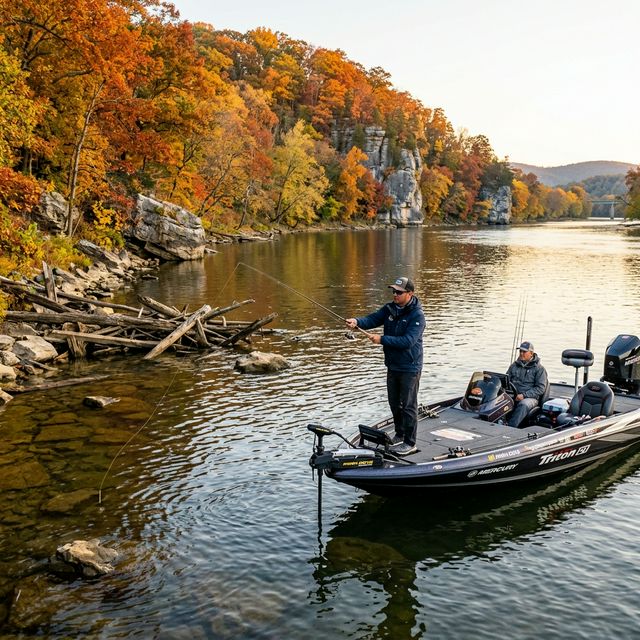
Maryland’s border waters involve some of the most complex jurisdictional rules on the East Coast. Here’s what you actually need to know:
Tidal Potomac (Below Great Falls to the Chesapeake Bay)
The tidal Potomac is governed by the Potomac River Fisheries Commission (PRFC):
- A valid Maryland or Virginia tidal license covers the main stem
- PRFC sets its own regulations — bag limits and seasons may differ from both Maryland and Virginia state regulations
- Striped bass rules on the tidal Potomac often mirror Maryland’s Bay rules, but always verify with the PRFC
- The boundary extends from the Virginia shoreline to the Maryland shoreline — the river itself is shared water
Nontidal Potomac (Above Great Falls to Harpers Ferry)
- A valid Maryland or West Virginia nontidal license covers the main stem
- From the bank: Follow the regulations of the state you’re physically standing in
- Popular non-resident destinations: Smallmouth bass fishing between Point of Rocks and Harpers Ferry is exceptional May through October
The Tributary Rule (Critical for Non-Residents)
Tributaries on each side require that specific state’s license. This is the rule that catches non-resident river anglers:
- Fishing the main Potomac with a Virginia license? Legal.
- Motor up the Monocacy River (a Maryland tributary) with that same Virginia license? Illegal. You need a Maryland nontidal license.
- Anchor in a Virginia creek mouth with only a Maryland license? Illegal. You need a Virginia license.
The practical test: If your boat is on the main Potomac channel, either bordering state’s license works. The moment you enter a tributary, side channel, or step onto a bank, you’re in that state’s jurisdiction.
Chesapeake Bay (Maryland-Virginia)
The state line runs approximately through the center of the Bay south of Smith Island. Most non-residents fishing out of Maryland ports stay in Maryland waters. If your charter crosses into Virginia waters (rare from Maryland ports), the captain will typically inform you.
Cost Comparison: Maryland vs. Mid-Atlantic Neighbors
Planning a multi-state East Coast trip? Here’s what you’ll pay everywhere:
| State | Annual NR Freshwater | Annual NR Saltwater | Trout Add-On | Total (All Waters + Trout) |
|---|---|---|---|---|
| Maryland | $55.00 | $22.50 | $30.00 | $107.50 |
| Virginia | $47.00 | $25.00 | $23.00 | $95.00 |
| Pennsylvania | $60.97 | N/A (no coast) | $14.97 | $75.94 |
| Delaware | $20.00 (covers all waters) | Included | $6.20 | $26.20 |
| New Jersey | $34.00 | Free (registration) | $20.00 | $54.00 |
| West Virginia | $50.00 (license + CS stamp) | N/A | $16.00 | $66.00 |
Multi-state strategy: The classic “Mountains to Bay” run — Deep Creek Lake bass one week, Chesapeake rockfish the next — costs $77.50 for both Maryland licenses. Add Pennsylvania’s Youghiogheny for $75.94 more, and you get three dramatically different fisheries for around $153 total. Or go the budget route: Delaware’s $26.20 total covers freshwater, saltwater, and trout — the best deal in the Mid-Atlantic for visiting anglers.
Why Maryland Costs More (And Why It’s Worth It)
Maryland’s $107.50 all-waters-plus-trout total is the highest in the Mid-Atlantic. But context matters:
- No other state in the region offers the Chesapeake Bay — the largest estuary in North America, with world-class striped bass, blue catfish, and crabbing
- Maryland’s $22.50 annual saltwater license is among the cheapest on the Atlantic — you’re paying a premium on the freshwater side, not the saltwater side
- Deep Creek Lake + Chesapeake Bay represent two of the most diverse fisheries within driving distance of the D.C.-Baltimore-Philadelphia corridor
- The 3-day option at $35.00 makes weekend freshwater trips reasonable for short visits

KastKing Blackhawk II Telescoping Rod
Portable telescoping design collapses to 17 inches. Perfect for travel fishing.
Affiliate link · Prices may vary
Exemptions: Who Fishes Free in Maryland
| Category | License Required? | Notes |
|---|---|---|
| Non-residents under 16 | ❌ Free | No license, no stamps, no registration needed |
| Blind anglers (resident or non-resident) | ❌ Free | Complimentary annual licenses available at DNR offices |
| Charter/headboat passengers | ❌ Free Bay license | Must have free Saltwater Angler Registration instead |
| Free Fishing Days (June 6, 13, July 4) | ❌ Free for everyone | All regulations still apply |
| Active-duty MD residents on leave | ❌ Exempt | Must have official military leave orders |
| Non-resident seniors 65+ | ✅ Full NR price | Senior pricing is MD-residents only |
| Non-resident disabled veterans | ✅ Full NR price | Veteran benefits are MD-residents only |
For age-related details, see the Maryland age requirements guide. For resident veteran benefits, see the veterans & disabled guide.
Penalties for Fishing Without a License
Maryland DNR Natural Resources Police actively patrol both freshwater and tidal waters. Getting caught without a valid license isn’t a slap on the wrist:
| Violation | Potential Penalty |
|---|---|
| Fishing without any license | Up to $500 fine |
| Fishing with wrong license type (e.g., nontidal in tidal waters) | Up to $500 fine |
| Striped bass violations (slot, bag limit) | Up to $1,000 fine + rod/reel confiscation |
| Repeat offenses | Increased fines + potential license suspension |
Enforcement reality: DNR officers frequently check licenses at boat ramps, popular piers, and on the water via patrol boats. Having your COMPASS confirmation on your phone is the easiest way to show proof. Officers can also verify your license status by name and date of birth through their system.
Five Mistakes Non-Residents Make in Maryland
Buying only one license — Maryland’s split system catches nearly every first-time visiting angler. If your trip includes both freshwater and Chesapeake Bay fishing, you need the nontidal license ($55) and the Bay & Coastal license ($22.50). Buying only one means you’re fishing illegally in the other water type.
Forgetting the Trout Stamp on mountain streams — Maryland’s $30 non-resident Trout Stamp is required for fishing in designated trout waters, even if you’re catch-and-release only. If you’re heading to Savage River, Gunpowder Falls, or any Put-and-Take area, add it at checkout.
Assuming Potomac River reciprocal rules cover tributaries — The Maryland-Virginia reciprocal agreement covers the main stem Potomac only. The moment you enter a tributary or creek feeding the Potomac, you need the license of whichever state that tributary is in.
Not knowing the striped bass slot limit — The 19–24 inch slot catches visitors off guard. In many states, there’s a minimum size only. Maryland requires your fish to be within a window — both too small and too large fish must be released.
Missing the August closure — Maryland completely closes all striped bass fishing for the entire month of August. No catch and release, no targeting. Visitors planning August Bay trips should target blue catfish, white perch, or bluefish instead.
Source: Maryland Department of Natural Resources, verified March 2026. Prices reflect 2025-2026 fee schedule effective June 1, 2025. Reciprocal fees may apply — check COMPASS for your state’s specific rates.