 FishKillFlea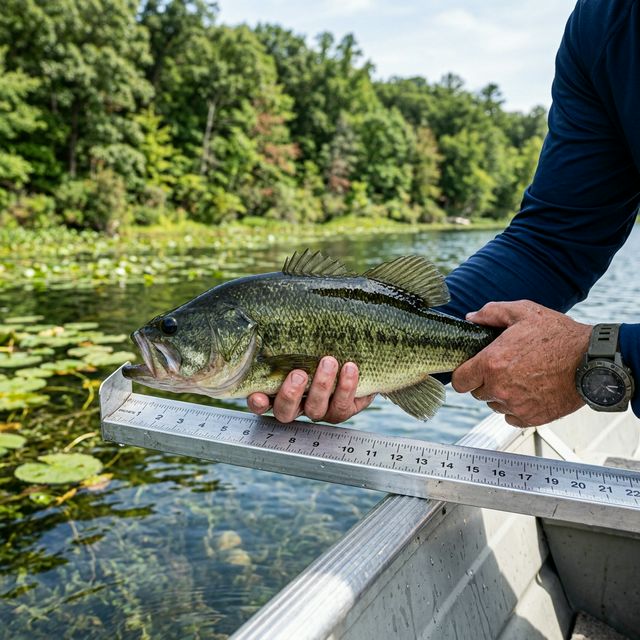
You’ve been casting jigs into the submerged brush piles along the east bank of Blue River for two hours, and you’ve finally connected with a solid smallmouth. It fights hard in the current, bulldog headshakes pulling your medium-light rod into a deep arc. When you finally lip it in the shallows, you pull out the tape measure: 13 inches. Solid fish. Keeper? You hesitate. Back on Lake Monroe last weekend, 13 inches would have been too short — the lake minimum is 14 inches. But you’re on a river now, and Indiana rivers have different rules. You check the regulation book on your phone: on rivers and streams, no bass between 12 and 15 inches may be kept. Your 13-inch fish falls squarely in the protected slot. It goes back.
This is the most common regulatory mistake in Indiana — applying lake rules to river fish. Indiana is one of the few states that maintains completely different bass regulations for lakes versus rivers and streams, and the distinction trips up even experienced anglers. Beyond bass, there’s a geographic walleye dividing line at State Road 26, lakes with their own special regulation packages, and a trout stamp system that applies to specific designated waters. Indiana’s fishing is excellent, but the rules require attention to detail.
Major Species: Statewide Bag and Size Limits
Bass (Largemouth, Smallmouth, Spotted — Combined)
| Water Type | Daily Bag Limit | Minimum Size | Special Rules |
|---|---|---|---|
| Lakes & Reservoirs | 5 (any combo) | 14 inches | Straightforward minimum |
| Rivers & Streams | 5 (any combo) | No fish 12”–15” (slot) | Max 2 fish over 15” allowed |
| Lake Michigan | 3 (any combo) | 14 inches | Lower bag limit than inland lakes |
The river slot explained: On Indiana rivers and streams, you can keep bass under 12 inches or over 15 inches, but you cannot keep any bass that measure between 12 and 15 inches. This protects the breeding-size fish that are critical to stream populations. Additionally, of the 5-fish limit, no more than 2 can be over 15 inches. This dual restriction is uniquely Indiana and catches visiting anglers off guard.
Walleye (Including Sauger and Saugeye in Aggregate)
| Region | Daily Bag Limit | Minimum Size |
|---|---|---|
| North of State Road 26 | 6 | 16 inches |
| South of State Road 26 | 6 | 14 inches |
Notable exceptions:
- Bass Lake (Starke County): 14-inch minimum
- Wolf Lake (Lake County): 14-inch minimum
- Lake George (Steuben County): 15-inch minimum
- Wall Lake (LaGrange County): 16-inch minimum, 2 fish daily limit
State Road 26 runs east-west across central Indiana, roughly through Lafayette and Portland. If you’re fishing north of this line (the natural lake region), walleye must be 16 inches. South of it (the reservoir region), 14 inches. This geographic split reflects the different walleye populations — northern Indiana’s natural lakes grow walleye slower, so the size limit is higher to protect them.
Crappie (Black and White Combined)
| Water Type | Daily Bag Limit | Size Limit |
|---|---|---|
| Statewide | 25 (black + white combined) | No statewide minimum |
| Dogwood Lake (Daviess County) | 25 | 9-inch minimum |
| Hardy Lake (Scott County) | 25 | 9-inch minimum |
Indiana’s 25-crappie daily limit is among the most generous in the Midwest. The possession limit is 50 (two daily limits). This reflects Indiana’s prolific crappie populations in its southern reservoirs — Patoka Lake, Monroe Lake, and Mississinewa Lake are all known for consistent crappie action.
Channel, Blue & Flathead Catfish
Indiana’s catfish regulations are often misunderstood because they differ significantly between lakes and streams:
| Water Type | Daily Bag Limit | Minimum Size | Trophy Protection |
|---|---|---|---|
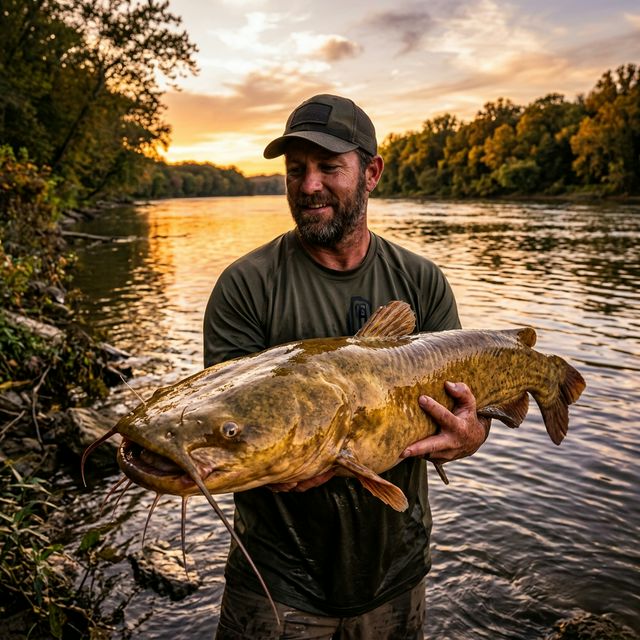
| Lakes & Reservoirs | 10 (channel, blue, flathead combined) | None | Max 1 blue catfish ≥35”, 1 flathead ≥35”, 1 channel ≥28” |
| Streams | Unlimited | 13 inches | Max 1 blue catfish ≥35”, 1 flathead ≥35”, 1 channel ≥28” |
| Bullhead | Unlimited | None | No trophy restriction |
The trophy protection rule: Regardless of water type, you may keep no more than one blue catfish 35 inches or longer, one flathead 35 inches or longer, and one channel catfish 28 inches or longer per day. This protects the large breeding-age catfish that anchor river and reservoir populations — particularly important on the Ohio River and Wabash River where trophy blues and flatheads over 50 pounds are targeted.
Other Important Species
| Species | Daily Bag Limit | Size Limit | Notes |
|---|---|---|---|
| Bluegill/Sunfish | No statewide limit | No statewide minimum | Some lakes limit to 15/day |
| Northern Pike | 3 | None | Not common in southern Indiana |
| Muskellunge | 1 | 36 inches | Trophy management — catch-and-release strongly encouraged |
| Striped/Hybrid Bass | 4 | 15 inches | Primarily in southern reservoirs |
| Trout (all species) | 5 | Varies by water | Requires $11 Trout/Salmon Stamp |
| Paddlefish | 2 | 24-inch eye-to-fork length | Ohio/Wabash rivers; special tag required |

Crab & Lobster Measurer
Stainless steel gauge ensures your catch meets minimum size regulations.
Affiliate link · Prices may vary
Trout and Salmon: The Stamp System
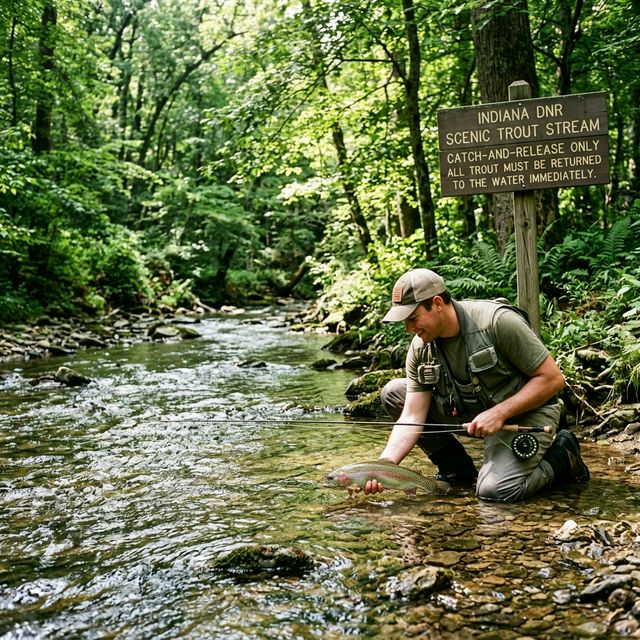
Indiana maintains designated trout and salmon waters that require the $11 Trout/Salmon Stamp in addition to a valid fishing license. Key designated waters include:
Lake Michigan Tributaries
- Trail Creek (Michigan City area) — steelhead and chinook salmon
- East Branch Little Calumet River — stocked rainbow trout
- Salt Creek (Porter County) — stocked trout
Inland Trout Streams
Indiana DNR stocks trout in selected streams and lakes throughout the state. These stocking locations have specific seasons and regulations. Common inland stocking sites include streams in state parks and fish & wildlife areas across central and southern Indiana.
The daily license shortcut: The $15 non-resident 1-day license includes trout/salmon privileges automatically. If you’re making a single day trip to Trail Creek for steelhead, the daily license at $15 is cheaper than the 7-day license ($35) plus the trout stamp ($11 = $46).

Rapala Stainless Steel Fishing Pliers
Stainless steel construction. Side cutter and split ring tool. Corrosion resistant.
As an Amazon Associate, we earn from qualifying purchases. Prices may vary.
Prohibited Methods and Gear
Indiana prohibits several fishing methods that are legal in some other states:
- Snagging — illegal for game fish (limited exceptions for certain rough fish species like carp and bowfin on specific waters)
- Spearing — prohibited in most waters (limited exceptions for rough fish on specific lakes)
- Trotlines/limb lines — legal on rivers and streams below normal pool level, but prohibited on reservoirs and most lakes
- Gill nets, seines, and fish traps — prohibited for recreational anglers
- Electric fishing devices — prohibited for recreational anglers
- Explosives/chemicals — prohibited (obviously)
Bait Restrictions
- Live fish as bait: Only certified dealer minnows from approved species may be used as live bait. You cannot use game fish, goldfish, or carp as bait
- Asian carp: Illegal to possess alive anywhere in Indiana
- Bait importation: Bringing live bait from other states is restricted — buy your bait locally in Indiana
- Corn/dough balls: Legal in Indiana (unlike some states)
- Multiple hooks: Generally no limit on number of lines or hooks, but some waters have specific restrictions

Plano 3700 Tackle Storage Box
Adjustable dividers. Durable construction. Perfect for organizing lures and tackle.
Affiliate link · Prices may vary
Special Lake Regulations: Check Before You Fish
Many Indiana lakes have regulations that differ significantly from statewide rules. These special regulations are lake-specific and often include different size limits, bag limits, or even artificial-only restrictions. Some examples:
| Lake | County | Species | Special Rule |
|---|---|---|---|
| Patoka Lake | Orange/Dubois/Crawford | Bass | 15” minimum (higher than statewide 14”) |
| Cecil M. Harden Lake (Raccoon SRA) | Parke | Bass | 16” minimum |
| Turtle Creek Reservoir | Sullivan | Bass | 20” minimum, 1/day |
| Fidler Pond | Elkhart | Bass | 2/day, 18” minimum |
| Failing Lake (Gentian Lake) | Steuben | Bass | 2/day, 18” minimum |
| Flat Fork Creek Ponds A & B | Hamilton | Bass | 2/day, 18” minimum |
| Ball Lake | Steuben | Bass | 2/day, 18” minimum |
| Big Long Lake | LaGrange | Bass | 12”–15” slot (river rules on a lake) |
| Wall Lake | LaGrange | Walleye | 2/day, 16” minimum |
| Dogwood Lake | Daviess | Crappie | 9” minimum |
| Hardy Lake | Scott | Crappie | 9” minimum |
| Ferdinand State Forest Lake | Dubois | Bass | 12”–15” slot, max 2 over 15” |
Always check the specific water: Indiana DNR publishes special regulations for dozens of individual lakes and streams. Before fishing any water for the first time, check the Indiana Fishing Regulations Guide for water-specific rules. The statewide limits are the baseline — special regulations may be more restrictive.
2026 Regulation Updates
Indiana updates its fishing regulations annually. Key areas to monitor for 2026 changes include:
- Walleye management in northern lakes — ongoing population monitoring may result in adjusted limits
- Muskie management — continued emphasis on catch-and-release for trophy management
- Invasive species — monitoring for Asian carp migration up the Wabash River and potential new restrictions
- Trout stocking locations — DNR may add or remove designated trout waters based on stocking program performance
Check the official 2025-2026 Indiana Fishing Regulations Guide for the most current rules.
Five Rules That Trip Up Indiana Anglers
Lake rules vs. river rules for bass — This is the number one enforcement issue. The 14-inch minimum on lakes becomes a 12-to-15-inch protected slot on rivers and streams. Know which water type you’re fishing and measure accordingly.
The SR-26 walleye line — North of State Road 26, walleye must be 16 inches. South, only 14. If you fish near this line (Lafayette area), make sure you know which side you’re on.
Trout stamp confusion — The stamp is only needed for designated trout/salmon waters, not for all Indiana fishing. But if you catch a trout accidentally in non-designated waters (it happens — stocked fish wander), you’re not in violation as long as you’re not specifically targeting trout/salmon waters.
Possession limits at camp — The 2× daily limit possession rule applies everywhere except your primary residence. At your lakeside cabin rental, in your cooler at camp, or in your vehicle — you cannot possess more than twice the daily bag limit. Process and store fish at your permanent home to reset.
Trotlines on reservoirs — Trotlines and limb lines are legal on rivers and streams below normal pool level, but illegal on Indiana’s reservoirs. If you’re running trotlines for catfish, stick to the Ohio River, Wabash River, or other stream systems — not Patoka Lake or Monroe Lake.
Source: Indiana Department of Natural Resources, verified March 2026. Regulations reflect the 2025–2026 Indiana Fishing Regulations Guide. Always verify special regulations for specific waters before fishing.