 FishKillFlea
· Guides · 9 min read
How Fish & Game Wardens Actually Work: What Every Angler Needs to Know (2026)
Reviewed by FishKillFlea Editorial Team
Game wardens can search your cooler without a warrant, board your boat without permission, and walk onto private land without asking. Here's what they can — and can't — legally do.
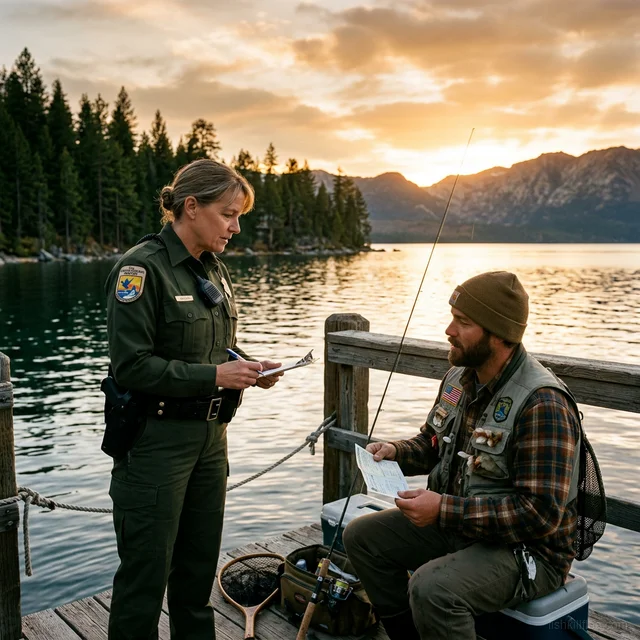
A game warden walks up to you at the dock, asks to see your fishing license, and then opens your cooler to count your catch. Did you just get searched without a warrant? Yes — and it’s almost always perfectly legal. Fish and game wardens operate under a unique set of legal powers that most anglers don’t understand. This guide explains what wardens can and can’t do, what to expect during a check, and how to protect your rights.
Who Are Fish & Game Wardens?
Game wardens go by many titles depending on the state:
| State Term | Examples |
|---|---|
| Conservation Officer (CO) | Michigan, Indiana, New York |
| Wildlife Officer | Ohio, North Carolina |
| Game Warden | Texas, California, North Dakota |
| Conservation Police Officer | Illinois |
| Natural Resources Police | Maryland |
| Environmental Conservation Officer (ECO) | New York |
| Fish & Wildlife Agent | Louisiana |
Regardless of title, they share one thing: full law enforcement authority. Game wardens are not park rangers or security guards. They are sworn law enforcement officers who carry firearms, make arrests, execute warrants, and can enforce ALL state laws — not just fish and game regulations.
By the Numbers
| Stat | National Average |
|---|---|
| Number of state game wardens | ~8,000 nationwide |
| Average salary | ~$60,620/year |
| Top-paying states | TX (~$70,740), CA, NJ, IN ($66,000–$70,000) |
| Territory per warden | 1 warden per ~500–2,000 square miles |
| Academy training | 6–12 months (law enforcement + wildlife biology) |
The ratio problem: With roughly 8,000 wardens covering 3.8 million square miles and 50+ million licensed anglers, each warden is responsible for an enormous territory. This means checks are infrequent — but when they happen, wardens are thorough.
What Happens During a Fishing License Check
Here’s exactly what to expect when a game warden approaches you:
Step 1: The Approach
The warden identifies themselves and shows their badge/credentials. They don’t need probable cause or reasonable suspicion to approach you — simply being engaged in or appearing to be engaged in fishing or hunting is sufficient justification for an administrative inspection.
Step 2: License and ID Request
The warden asks to see your fishing license and government-issued ID. You are legally required to produce these in all 50 states. Refusing to show your license is itself a violation.
What they’re checking:
- Valid license for the current date and state
- Required stamps and endorsements (trout stamp, saltwater endorsement, etc.)
- Your identity matches the license name
- Residency status matches the license type (resident vs. non-resident)
Step 3: Catch Inspection
The warden asks to see your catch. They may:
- Open your cooler, live well, stringer, or fish basket
- Count the number of fish by species
- Measure individual fish for size compliance
- Check your tackle (for banned methods/gear)
- Inspect bait (for banned live bait species)
Step 4: Outcome
| Situation | Typical Result |
|---|---|
| Everything checks out | ”Have a great day” — most checks take 5–10 minutes |
| Minor violation (expired license, 1 fish over limit) | Written citation with fine ($50–$250) |
| Serious violation (no license, way over limit, protected species) | Citation + potential equipment seizure |
| Egregious violation (commercial poaching, endangered species) | Arrest + criminal charges |

Pflueger President Spinning Reel
Smooth 10-bearing system. Great value for freshwater fishing.
Affiliate link · Prices may vary
The Legal Powers: What Wardens CAN Do
Game wardens have significantly broader search powers than regular police officers in most states. This is due to the “closely regulated activity” doctrine — fishing and hunting are considered regulatory activities with reduced privacy expectations.
1. Search Your Catch Without a Warrant
| Can Do | Legal Basis |
|---|---|
| Open coolers, live wells, game bags, stringers | Administrative search exception — fishing is a regulated activity |
| Count and measure your fish | Regulatory inspection during permitted activity |
| Check your vehicle’s trunk if fish are stored there | ”Plain view” doctrine or consent |
The key distinction: Wardens can inspect items related to your fishing activity (tackle, catch, storage) without a warrant. They cannot search your personal belongings (glove box, wallet, phone) without probable cause or consent, the same as any other officer.
2. Board Your Boat Without Permission
| Can Do | Legal Basis |
|---|---|
| Board your boat on public water | Safety and regulatory inspection authority |
| Check PFDs, fire extinguishers, registration | Coast Guard and state boating safety regulations |
| Inspect live wells and fish storage | Fishing enforcement |
Boating note: When you’re on the water, wardens have particularly broad authority. Maritime law and state boating statutes generally allow regulatory boarding without a warrant. Refusing to allow boarding can result in additional charges.
3. Enter Private Property (Open Fields)
| Can Do | Limitation |
|---|---|
| Walk onto your unposted farmland | Open Fields Doctrine — no warrant needed for land outside your home and yard |
| Access your shoreline through navigable waterays | Public trust doctrine — navigable waters are public |
| Enter your property along waterways to check anglers | Reasonable access for regulatory purposes |
| Cannot enter your home or curtilage (yard, porch, garage) | Fourth Amendment requires a warrant for homes |
Important 2024 development: A Tennessee court ruled that warrantless searches by game wardens on private property were unconstitutional as applied by TWRA — the first significant recent court challenge to the Open Fields Doctrine in a wildlife enforcement context. This case may influence other states. — 待核实(case still moving through appeals as of 2026)
4. Stop and Detain You
| Can Do | Legal Basis |
|---|---|
| Stop you on the road if you’re transporting fish/game | Reasonable suspicion + regulatory authority |
| Set up checkpoint stations during peak fishing season | Administrative checkpoint authority (similar to DUI checkpoints) |
| Detain you while verifying your license | Regulatory stop — brief and limited |
What Wardens CANNOT Do
| Cannot Do | Why |
|---|---|
| Search your home without a warrant | Fourth Amendment applies fully to residences |
| Search your person for drugs/weapons without probable cause | Fishing inspection doesn’t justify general law enforcement search |
| Demand your phone or digital records | Protected by Fourth Amendment (Riley v. California) |
| Enter posted/fenced property near your home without a warrant | Curtilage is protected |
| Use excessive force | Subject to all use-of-force laws |
| Racially profile or discriminate | Subject to all civil rights protections |

Ugly Stik Elite Spinning Rod
Premium Ugly Stik with improved sensitivity and lighter weight.
As an Amazon Associate, we earn from qualifying purchases. Prices may vary.
A Day in the Life of a Game Warden
What does a warden’s typical shift actually look like? Understanding their workflow helps you understand why they do what they do:
Dawn Patrol (5:00 AM – 10:00 AM)
- Patrol popular fishing spots during peak bite hours
- Check boat ramps and launches
- Look for anglers in restricted areas or during closed seasons
- Monitor for commercial fishing violations in recreational zones
Midday (10:00 AM – 2:00 PM)
- Paperwork and case documentation
- Follow up on tip-line reports (Operation Game Thief / Turn In Poachers)
- Coordinate with neighboring wardens on border water issues
- Community outreach — school visits, fishing clinics, youth programs
Afternoon/Evening (2:00 PM – Dark)
- Waterborne patrols on lakes and rivers
- Checkpoint operations at boat ramps during tournament season
- Night fishing enforcement where applicable
- Emergency response (drownings, boating accidents, search and rescue)
The Seasonal Cycle
| Season | Primary Focus |
|---|---|
| Spring (March–May) | Spawning protection, stream closures, new license year checks |
| Summer (June–August) | Peak fishing season — highest check volume, boating safety |
| Fall (September–November) | Hunting season overlap, salmon/steelhead runs |
| Winter (December–February) | Ice fishing checks, off-season poaching patrols |
Your Rights During an Encounter
Do
- ✅ Remain calm and polite — wardens encounter hostile people regularly
- ✅ Present your license and ID promptly
- ✅ Allow inspection of your catch when asked
- ✅ Ask for clarification if you don’t understand a regulation
- ✅ Note the officer’s name and badge number
- ✅ Accept the citation (you can contest it in court later)
- ✅ Comply first, then file a complaint through proper channels if warranted
Don’t
- ❌ Refuse to show your license — this is a separate violation
- ❌ Throw fish back when you see a warden approaching — this is “destruction of evidence” and wardens are trained to watch for it
- ❌ Run or physically resist — game wardens have arrest authority
- ❌ Lie about where you fished or what you caught — false statements to a law enforcement officer is a crime
- ❌ Consent to searches beyond what’s required — you can politely decline general searches of personal items unrelated to fishing
- ❌ Argue regulations on the spot — the citation is the time to comply; court is the place to argue
The #1 mistake anglers make: Tossing fish overboard when they see a patrol boat approaching. Wardens expect this — they often observe from a distance before approaching, and they’ve already counted your fish through binoculars. Now you’ve added “evidence tampering” to your potential violations.

Penn Pursuit IV Spinning Combo
Rod and reel combo ready to fish out of the box. Great value for new anglers.
Affiliate link · Prices may vary
How Wardens Catch Poachers (Their Tools)
| Tool | How It’s Used |
|---|---|
| Binoculars/spotting scopes | Observing anglers from concealment before approaching |
| Covert cameras | Trail cameras at poaching hotspots, remote fishing locations |
| Tip lines | Every state has a “Turn In Poachers” (TIP) or “Operation Game Thief” hotline. Reports are anonymous |
| Social media monitoring | Checking Facebook, Instagram, and fishing forums for evidence of violations |
| Undercover operations | Wardens posing as anglers at commercial bait shops or fishing tournaments |
| GPS tracking | Licensed by courts on vehicles of suspected commercial poachers |
| DNA evidence | Matching fish/meat to specific water bodies or species for wildlife trafficking cases |
Social media warning: If you post a photo of your catch on Facebook and it shows 8 fish with a 5-fish limit, wardens can and will use that as evidence. Geotagged photos are particularly useful — they prove where you were fishing. Multiple states have prosecuted anglers based on social media posts.
How to Report Violations
If you witness poaching, illegal netting, fishing in closed waters, or other violations:
| State | Tip Line | How to Report |
|---|---|---|
| Texas | Operation Game Thief | 1-800-792-GAME (4263) |
| Florida | Wildlife Alert | 888-404-3922 |
| California | CalTIP | 1-888-334-2258 |
| Michigan | Report All Poaching (RAP) | 1-800-292-7800 |
| New York | DEC | 1-844-DEC-ECOS |
| All other states | Search “[state] report poaching hotline” | Most offer anonymous reporting + cash rewards |
Rewards: Many states offer cash rewards ($100–$1,000+) for tips that lead to successful prosecution of serious violations.
Frequently Asked Questions
Can a game warden search my cooler? Yes — in all 50 states, game wardens can inspect your catch (coolers, live wells, stringers, game bags) during a fishing license check without a warrant. This falls under the administrative search exception for closely regulated activities. However, they cannot search unrelated personal property without probable cause or consent.
Do I have to show a game warden my fishing license? Yes — failing to produce a valid license when asked by an authorized officer is a violation in every state. Even if your license is free (senior, veteran), you must carry and present proof.
Can a game warden come on my property? Under the Open Fields Doctrine, game wardens can enter unposted open land outside your home and yard (curtilage) without a warrant. They cannot enter your home without a warrant or consent. However, recent court rulings (notably in Tennessee, 2024) are beginning to challenge wardens’ warrantless property entry — 待核实 (case ongoing).
What happens if I get a citation? A fishing license citation is typically a civil infraction or misdemeanor, similar to a traffic ticket. You’ll receive a fine amount and court date. You can pay the fine (admission of guilt) or appear in court to contest it. Fines range from $50 to $500+. See our Fishing License Penalties Guide for state-by-state fines.
Can I refuse to let a warden search my boat? Generally no — on public water, wardens have authority to board and inspect vessels for safety and fishing compliance. Refusing can result in additional charges. The best approach is to comply and contest in court if you believe the inspection was unlawful.
How do I become a game warden? Most states require a bachelor’s degree (wildlife biology, criminal justice, or related field), passing a law enforcement academy (6–12 months), and meeting physical fitness standards. Starting salary averages ~$60,000–$70,000 with benefits.
Know your state’s specific regulations on our state pages. For fine amounts, see our Penalties Guide. To understand your license requirements, check our Complete Exemptions Guide or License vs. Permit Guide.