 FishKillFlea
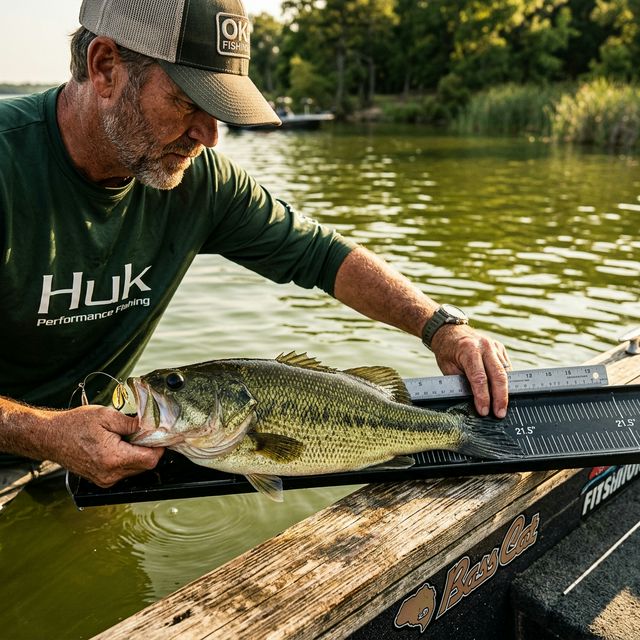
You throw a perfectly placed jig near a submerged laydown on Eufaula Lake. A textbook thump, a solid hookset, and moments later you’re lipping a beautifully patterned largemouth bass. You grab your measuring board—she hits 17.5 inches. It’s a great fish, and it’s headed for the livewell. An hour later, you stick another one that measures exactly 16.5 inches. If you toss that second bass into the livewell next to the first one, you’ve just broken Oklahoma state law.
Oklahoma is home to some of the best bass fishing in the country, but the Oklahoma Department of Wildlife Conservation (ODWC) manages this resource with a very specific set of statewide rules. Knowing the difference between the standard statewide limits and special management water regulations is the difference between a great day on the water and a citation back at the boat ramp.
Statewide Daily Bag & Size Limits for 2026
The following are the standard statewide limits according to the 2026 ODWC Fishing Regulations. Always check the specific lake or river you are fishing, as special regulations often override these baseline limits.
Bass (Largemouth & Smallmouth)
- Daily Limit: 6 (combined)
- Size Limit: Only ONE may be over 16 inches.
- Rivers & Streams exception: In rivers and streams, largemouth and smallmouth bass must be at least 14 inches long. Only one smallmouth bass is allowed per day within the combined limit of 6.
Spotted Bass
- Daily Limit: No limit
- Size Limit: No limit (Note: Spotted bass do not count toward your black bass combined limit).
Crappie (White & Black)
- Daily Limit: 37 (combined)
- Size Limit: No limit
Catfish (Channel & Blue)
- Daily Limit: 15 (combined)
- Size Limit: Only ONE Blue Catfish may be over 30 inches.
Flathead Catfish
- Daily Limit: 5
- Size Limit: No limit
Trout (Rainbow & Brown)
- Daily Limit: 3 (combined, statewide)
- Size Limit: No statewide size limit, but highly specific limits apply in designated trout areas (see Special Management Waters below).
- Important: Culling of trout is prohibited statewide — once you keep a trout, you cannot release it to upgrade.

Crab & Lobster Measurer
Stainless steel gauge ensures your catch meets minimum size regulations.
Affiliate link · Prices may vary
Uniquely Oklahoma: Paddlefish Snagging
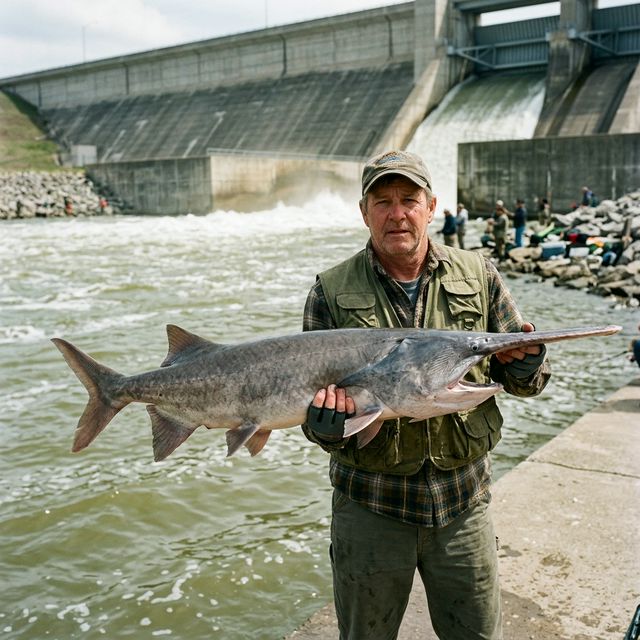
One of the most unique angling experiences in North America takes place in northeastern Oklahoma during the spring paddlefish run—specifically below the Keystone Lake dam and in the Neosho and Spring rivers.
Oklahoma is one of a handful of states that legally permits snagging for paddlefish (spoonbill), but the activity is tightly regulated to protect the prehistoric species:
- The Permit: In addition to a valid fishing license, you must possess a free Paddlefish Permit (available to both residents and non-residents at no cost through GoOutdoorsOklahoma.com or the app). The permit expires December 31 annually.
- Daily Limit: ONE paddlefish per day. Once you keep a paddlefish, you must stop snagging for the day.
- Annual Limit: TWO paddlefish per angler per year.
- Mandatory Reporting: You must report your paddlefish harvest to the ODWC’s E-Check system within 24 hours of keeping a fish.
- Barbless Hooks Only: Only one single hook or one treble hook is allowed, and all hooks must have barbs removed or completely closed.
- No Culling: It is illegal to catch, keep, and then later release a paddlefish to upgrade.
- Tagging: Once a paddlefish is kept, it must be immediately tagged with the angler’s Customer ID number.
- Night Snagging Prohibited: Snagging is prohibited from 10 p.m. to 6 a.m. in areas east of I-35 and north of I-40 (except at Miami City Park from the south boat ramp to the US-125 bridge).
- No Gaff Hooks: The use of gaff hooks or any device that injures the fish is prohibited when landing a paddlefish.

Rapala Stainless Steel Fishing Pliers
Stainless steel construction. Side cutter and split ring tool. Corrosion resistant.
As an Amazon Associate, we earn from qualifying purchases. Prices may vary.
Trotline, Throwline, and Jug Fishing Rules
Trotlines and juglines are deeply embedded in Oklahoma’s catfishing culture. To keep waterways clear of abandoned gear, the ODWC enforces strict gear rules:
- Identification: Every unattended trotline, throwline, jugline, or yo-yo must have the angler’s name and address, OR their ODWC Customer ID number, securely attached.
- Checking Lines: All unattended gear must be attended (physically checked) at least once every 24 hours.
- Hook Limits: A single trotline may not have more than 100 hooks. You cannot use metallic materials (like wire cable) for the main line.
- Navigable Channels: You cannot run a trotline fully across a navigable channel or stream in a way that blocks boat traffic.

Plano 3700 Tackle Storage Box
Adjustable dividers. Durable construction. Perfect for organizing lures and tackle.
Affiliate link · Prices may vary
Possession Limits (Non-Resident Warning)
For out-of-state anglers planning multi-day trips to Oklahoma, the possession limit is critical.
Your possession limit is the total number of fish you are allowed to have in your cooler, cabin, or vehicle while you are not actively returning from a single day’s fishing. In Oklahoma, the possession limit is two times the daily bag limit.
If you are a non-resident driving home to Texas after a three-day crappie trip to Eufaula, you cannot legally transport 111 crappie (3 days x 37 daily limit). You max out at the possession limit of 74 crappie (2 days x 37 daily). If a game warden checks your cooler on the highway over the 74 limit, you will be cited.
Special Management Waters
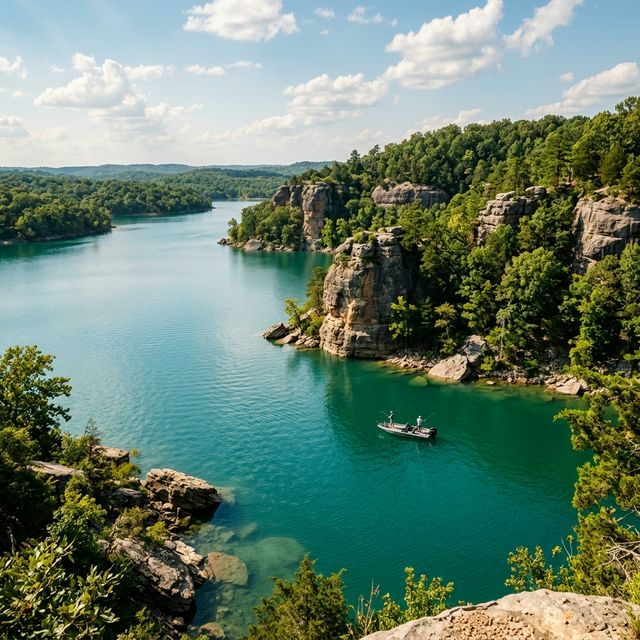
Oklahoma uses “Special Management Waters” to designate lakes and rivers with rules that override the statewide limits. Some common examples include:
Lower Mountain Fork River (Trout)
The tailwater below Broken Bow Dam is Oklahoma’s premier year-round trout fishery. It features specific Red Zones (unbaited artificial lures with barbless hooks only) and Blue Zones, with strict size requirements (e.g., all brown trout must be released; rainbow trout limits are highly restrictive).
Lake Texoma
Because it borders Texas, Lake Texoma requires its own $12 Lake Texoma Fishing License (Type 208) — regular Oklahoma or Texas state licenses do NOT cover Texoma. The crappie limit on Texoma is 37, and the striped bass limit is 10 (with only two allowed over 20 inches). See the non-resident guide for full Texoma details, exemptions, and bag limits.
Close to Home Fishing Waters
Dozens of municipal ponds in Oklahoma City, Tulsa, and smaller towns are designated as “Close to Home” waters. These are heavily stocked for urban recreation but carry extreme restrictions: generally, the daily limit is 3 channel catfish and 3 largemouth bass, and many ponds are catch-and-release only for bass.
Key Takeaways
- One-Over 16: The most important bass rule to remember. You can keep 6, but only one can be over 16 inches.
- Paddlefish: 1 daily, 2 annual. The permit is free for everyone, but daily and annual harvest limits are strictly enforced. Barbless hooks only, no culling.
- Label your jug lines: If you’re leaving gear in the water overnight, it must have your Customer ID on it. As of January 2025, this applies to ALL unattended fishing equipment.
- Lake Texoma needs its own $12 license. Your regular Oklahoma fishing license does NOT work on Texoma.
- Check the non-resident possession limit: You can only take home two daily bag limits inside your cooler.
- Trout limit is 3 statewide. No culling allowed — once you keep a trout, it stays.
- Download the GoOutdoors Oklahoma App: It contains the full, searchable 2026 regulations rulebook with GPS-based lake-specific rules.
- Ensure you have the correct fishing license before wetting a line, and remember that youth under 18 fish completely free.
Source: Oklahoma Department of Wildlife Conservation — all data verified March 2026.