 FishKillFlea
You’ve just set the hook on what feels like a solid largemouth bass, flipping jigs near a submerged cedar tree on Table Rock Lake. You swing the fish over the gunnel—it’s a chunk. You grab your metal bump board, slide the jaw against the zero mark, pinch the tail. The measurement reads 14 inches. On most Missouri lakes with no length limit, that fish goes in the livewell. On Table Rock, with its lake-specific 15-inch minimum for largemouth, putting that fish in the livewell earns you a citation.
That single scenario illustrates the core challenge of fishing in Missouri: knowing the statewide regulations is only half the battle. The Missouri Department of Conservation (MDC) manages one of the most diverse fisheries in America—from 90,000-acre impoundments to crystal-clear Ozark spring creeks—and relies heavily on localized, water-specific rules that supersede the statewide defaults.
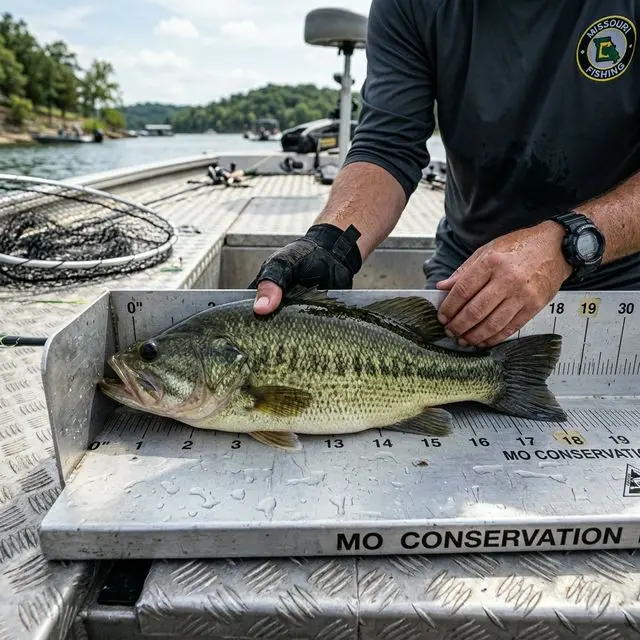
Statewide Default Bag & Size Limits (2026)
These limits apply unless a specific lake, river, or conservation area has posted special regulations. The possession limit is double the daily limit for all species.
| Species | Daily Limit | Minimum Length | Season |
|---|---|---|---|
| Black Bass (LM, SM, Spotted) | 6 combined | None (lakes) / 12” (streams) | Year-round (lakes); May 24 – Feb 28 (most streams south of MO River) |
| Crappie (White & Black) | 30 combined | None | Year-round |
| Channel Catfish | 10 | None | Year-round |
| Blue Catfish | 5 | None | Year-round |
| Flathead Catfish | 5 | None | Year-round |
| Walleye & Sauger | 4 combined | 15” | Year-round |
| White Bass, Striped Bass & Hybrids | 15 combined | None (only 4 may be over 18”) | Year-round |
| Paddlefish | 2 | 24” (body length, excluding paddle) | March 15 – April 30 (snagging only) |
The Possession Rule
All fish must remain whole and intact (head, tail, and skin attached) while you are on state waters or the adjacent banks where length limits apply. You cannot fillet, clean, or process your catch until you have physically left the fishing area. This exists so conservation agents can verify species and length.
Additionally, stored fish (at home, camp, or lodging) must be labeled with your full name, address, Conservation Number, species, and the date stored.

Crab & Lobster Measurer
Stainless steel gauge ensures your catch meets minimum size regulations.
Affiliate link · Prices may vary
Major Lake-Specific Regulations
This is where Missouri fishing gets complex. The state’s most popular destination lakes have their own rules that override the statewide defaults. Memorizing the statewide chart alone is not enough.
| Lake | Black Bass Limit | Bass Length Limit | Crappie Limit | Crappie Length | Walleye/Sauger |
|---|---|---|---|---|---|
| Table Rock | 6 | 15” LM/SM; 12” Spotted (eff. April 30, 2026) | 15 | 10” | 4 / 18” min |
| Bull Shoals | 6 | 15” LM/SM; 12” Spotted | 15 | 10” | 4 / 18” min |
| Lake of the Ozarks | 6 | 15” LM/SM; 12” Spotted | 30 | None | 4 / 15” |
| Truman Lake | 6 | 15” LM/SM; 12” Spotted | 30 | None | 4 / 15” |
| Stockton Lake | 6 | 15” LM/SM; 12” Spotted | 15 | 10” | 4 / 18” min |
| Mark Twain Lake | 6 | 15” (all bass) | 30 | None | 4 / 15” |
| Smithville Lake | 6 | 15” (all bass) | 30 | None | 4 / 15” |
Key pattern: Most border impoundments and major Ozark lakes enforce a 15-inch minimum on largemouth and smallmouth bass with a 12-inch spotted bass minimum. Crappie limits on these lakes often drop to 15 per day with a 10-inch floor.

Rapala Stainless Steel Fishing Pliers
Stainless steel construction. Side cutter and split ring tool. Corrosion resistant.
As an Amazon Associate, we earn from qualifying purchases. Prices may vary.
Seasonal Closures
Black Bass Stream Closure (South of Missouri River)
The most impactful seasonal restriction in Missouri applies to black bass possession in streams south of the Missouri River. From March 1 through May 23, you cannot possess any black bass caught from these streams. Catch-and-release fishing with immediate release is still allowed, but you must not place a bass in a livewell, on a stringer, or in a cooler during this window.
Streams north of the Missouri River do not have this seasonal closure—bass can be possessed year-round with a 12-inch minimum.
Paddlefish (Spoonbill) Snagging
Snagging for paddlefish is a beloved Missouri tradition concentrated on Lake of the Ozarks and Truman Lake. The statewide season runs from March 15 through April 30 only. Outside of this window, no paddlefish may be taken. A valid fishing permit is required, and the daily limit is 2 with a 24-inch minimum body length (measured from the eye to the fork of the tail, not including the rostrum/paddle).

Plano 3700 Tackle Storage Box
Adjustable dividers. Durable construction. Perfect for organizing lures and tackle.
Affiliate link · Prices may vary
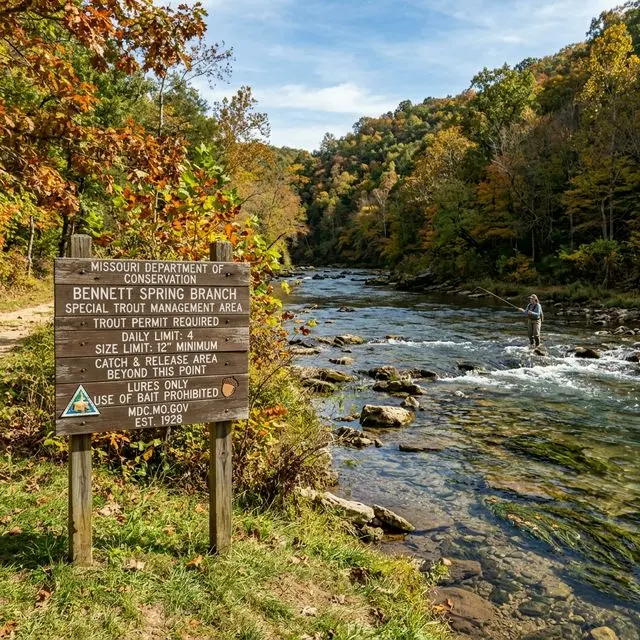
Special Management Waters: Trout
Missouri’s trout management is the most complex regulatory system in the state. The MDC uses a color-coded ribbon designation to categorize trout waters, and understanding the differences is essential before you make a single cast.
The Four State Trout Parks
Bennett Spring, Roaring River, Montauk, and Maramec Spring operate under their own park-specific rules:
- Catch-and-keep season: March 1 – October 31
- Required permits: Annual Trout Permit ($12 resident / $40 non-resident) PLUS a Daily Trout Tag ($5 for 16+ / $3 for youth)
- Daily trout limit: 4 trout (tag limit)
- Fishing hours: Controlled by a horn—the morning horn signals fishing start, the evening horn signals stop
- Catch-and-release season: November 1 – February 28 (trout permit required, no daily tag needed)
Blue Ribbon Trout Areas
Highest protection level. Focused on wild, naturally reproducing trout populations.
- Daily limit: 1 trout, minimum 18 inches
- Tackle: Flies and artificial lures ONLY (no soft plastics, no natural bait, no scented lures)
- Purpose: Trophy catch-and-release fishery with minimal harvest
Red Ribbon Trout Areas
Quality wild trout fisheries with limited harvest.
- Daily limit: 2 trout, minimum 15 inches
- Tackle: Artificial lures only (including flies)
- Purpose: Quality over quantity—targeting larger fish
White Ribbon Trout Areas
High-use “put-and-take” fisheries, regularly stocked by the MDC.
- Daily limit: 4 trout (no length limit for rainbow trout; brown trout have a 15-inch minimum, only 1 brown per day)
- Tackle: All types allowed, including live bait and soft plastics
- Purpose: Accessible family fishing
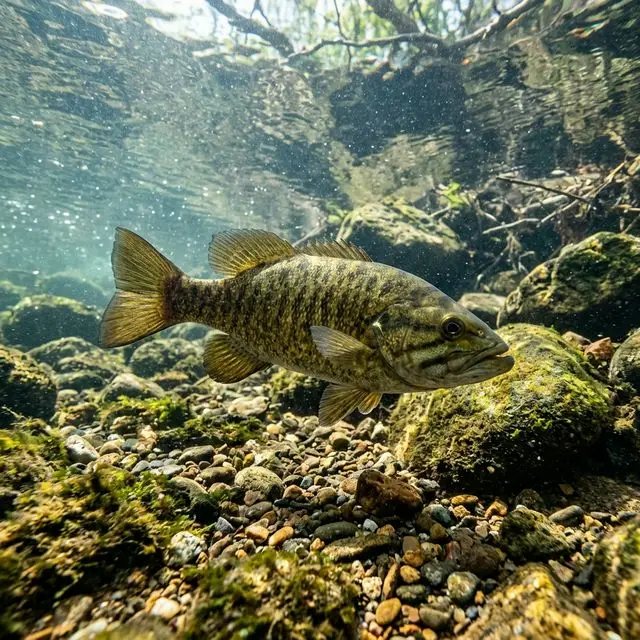
Special Management Waters: Smallmouth Bass
On iconic Ozark rivers—the Current, Jacks Fork, Eleven Point, North Fork of the White, and stretches of the Meramec—the MDC designates specific river miles as smallmouth bass management areas. In these zones, regulations tighten significantly:
- Daily limit: Drops from 6 to 1 smallmouth bass
- Minimum length: Increases from 12” to 15 or 18 inches (varies by section)
- Largemouth/spotted bass: Often still at standard stream limits in the same water
These restrictions exist because Ozark smallmouth grow slowly in the cold, spring-fed streams. A 15-inch smallmouth in an Ozark river can be 8-10 years old. Removing too many adults devastates the population for years.
2026 Regulation Change: Table Rock Spotted Bass
The most significant rule change for the 2026 season was approved by the MDC Conservation Commission in February 2026 and takes effect April 30, 2026:
The minimum length limit for spotted (Kentucky) bass on Table Rock Lake will drop from 15 inches down to 12 inches. Largemouth and smallmouth bass remain at 15 inches.
Why this matters: MDC biological surveys found that spotted bass now constitute 38% of Table Rock’s total black bass population, and many spotted bass never reach 15 inches before the end of their natural lifespan. The MDC determined that encouraging anglers to harvest 12-14 inch spotted bass would reduce interspecies competition and benefit largemouth and smallmouth populations. This change also aligns Missouri’s portion of Table Rock with the Arkansas regulations already in place on the southern half of the lake.
Tackle and Method Rules
Beyond species limits, the MDC enforces statewide tackle restrictions:
- Maximum 3 poles (or 3 banklines, throwlines, or trotlines) per angler at any time—except on the Mississippi River
- Maximum 33 hooks total across all lines and poles
- Snagging is legal only for paddlefish during the designated season and for non-game fish (like gar) in certain waters
- Trotlines and banklines must be tagged with the angler’s full name and address and checked at least once every 24 hours
- Gigging for suckers and non-game fish is permitted at night with a valid fishing permit