 FishKillFlea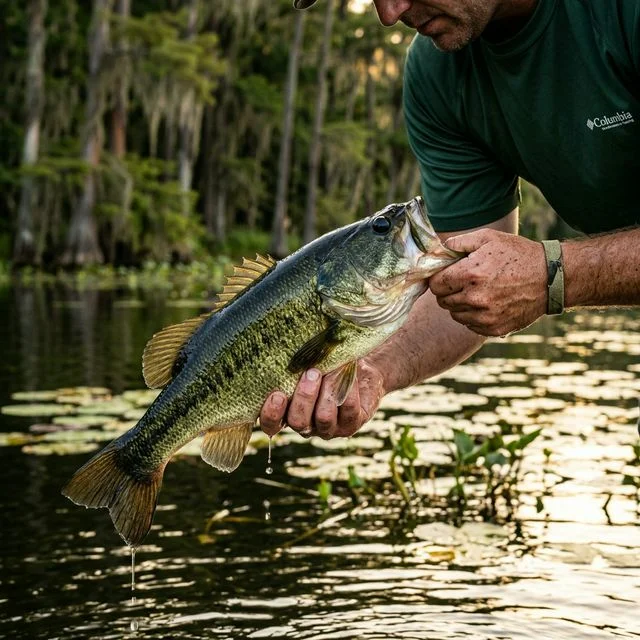
You pull a thick-shouldered largemouth from behind a stump on Guntersville. Looks big enough — maybe 14 inches? You reach for the ruler set into your boat gunwale. Fourteen and a half. On most Alabama waters, that fish goes in the livewell without a second thought. But on Guntersville, the minimum is 15 inches. Half an inch just turned a keeper into a violation.
Then you cross the dam and fish Wheeler. Same Tennessee River system, different reservoir. Here the largemouth minimum drops to 12 inches — but the creel limit shrinks from 10 to 5. Different reservoir, different rules, same river.
Alabama manages fishing with surgical precision. Each reservoir has its own regulations based on independent fishery surveys. The state’s Hunting and Fishing Digest runs over 100 pages for a reason. Here’s what matters most.
Black Bass: Statewide Rules and Reservoir-Specific Exceptions
Statewide Default
- Daily creel limit: 10 black bass (any combination of largemouth, smallmouth, spotted, Alabama, and shoal bass)
- Smallmouth limit: No more than 5 of the 10 may be smallmouth
- No statewide size limit on black bass unless specific water restrictions apply
- Measurement: Total length from front of closed mouth to tip of compressed tail
Reservoir-Specific Overrides
This is where Alabama gets complicated — and where most violations happen. Every major reservoir has its own rules:
| Water Body | Species Affected | Size Restriction | Creel Override |
|---|---|---|---|
| Guntersville | Largemouth & Smallmouth | Min. 15 inches | Statewide (10) |
| Pickwick | Largemouth & Smallmouth | Min. 15 inches | Statewide (10) |
| Wheeler | Largemouth & Spotted | Min. 12 inches | 5 bass |
| Wheeler | Smallmouth | Min. 15 inches | Within 5-bass limit |
| Wilson (+ Big Nance & Town Creeks) | Smallmouth only | Min. 15 inches | Statewide (10) |
| Lewis Smith | LMB, Alabama Bass, Spotted | Slot: no possession 13”–15” | Statewide (10) |
| Harris | Largemouth only | Slot: no possession 13”–16” | Statewide (10) |
| Eufaula (Walter F. George) + tribs | Largemouth only | Min. 14 inches | Statewide (10) |
| West Point + tributaries | Largemouth only | Min. 14 inches | Statewide (10) |
| Lake Jackson (Florala) | Black bass | 5 over 12”, only 1 over 22” | Special |
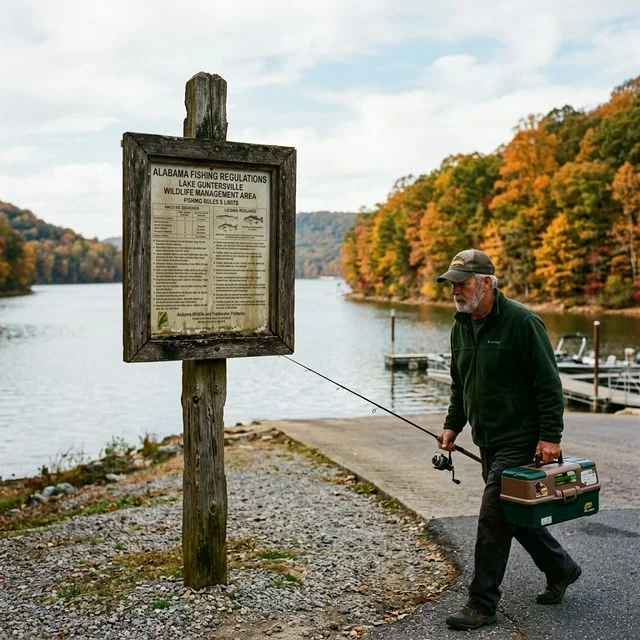
Why the variation? Alabama’s Wildlife and Freshwater Fisheries Division manages each reservoir independently based on electrofishing surveys, age/growth studies, and spawning success data. Slot limits at Smith and Harris protect mid-size fish during their prime spawning years. Minimum sizes at Guntersville and Pickwick give younger fish time to reach breeding age. Wheeler’s reduced creel (5 instead of 10) limits total harvest pressure.
The Smith Lake slot explained: “No possession 13–15 inches” means you must immediately release any bass between 13 and 15 inches. You can keep fish under 13 inches (harvest encouraged) and over 15 inches. The state actually wants anglers to remove smaller bass to reduce competition for the protected spawners.
Crappie Regulations
Statewide Rules
- Daily creel limit: 30 crappie
- Minimum size: 9 inches total length on most public waters
Exception Waters (No 9-Inch Minimum)
The following waters are exempt from the 9-inch crappie minimum — you may keep crappie of any size:
- Impoundments under 500 surface acres
- Chattahoochee River reciprocal waters and its impoundments/tributaries
- Bear Creek Reservoir (Big Bear Lake of the B.C.D.A. Lakes)
- Lake Jackson at Florala
Weiss Reservoir Special Rule
- Weiss Reservoir: 10-inch minimum crappie size (stricter than statewide 9-inch)

Crab & Lobster Measurer
Stainless steel gauge ensures your catch meets minimum size regulations.
Affiliate link · Prices may vary
Catfish Regulations
- No daily creel limit for catfish under 34 inches — take as many as you want
- Only 1 catfish over 34 inches may be kept per day, per person
The 34-Inch Transport Law (New — Effective October 2025)
As of October 1, 2025, Alabama House Bill 596 (HB596) makes it unlawful to transport live catfish 34 inches or greater beyond Alabama’s state borders if harvested from public waters.
| Violation | Classification | Minimum Fine |
|---|---|---|
| First offense | Class B misdemeanor | $2,000 |
| Subsequent offenses | Class A misdemeanor | $2,000+ |
This law targets commercial exploitation of Alabama’s trophy catfish population. If you catch a 36-inch flathead, you can eat it in Alabama — you cannot put it in a live tank and drive it to Georgia.
Basin Exemptions
The 34-inch daily limit rule does not apply to catfish taken from these river basins:
- Perdido River basin
- Conecuh River basin
- Blackwater River basin
- Yellow River basin
- Choctawhatchee River basin
- Chipola River basin
- Chattahoochee River basin
These southeastern Alabama basins are managed differently because their catfish populations and ecosystems are biologically distinct from the Tennessee River system.
Trout Regulations: Sipsey Fork
Alabama has one primary trout fishery — the Sipsey Fork below Smith Lake Dam. The cold water discharge from the dam sustains rainbow trout year-round in an otherwise warm-water state.
| Rule | Sipsey Fork Regulation |
|---|---|
| Species | Rainbow trout (stocked monthly, ~3,000 fish per stocking) |
| Daily creel limit | 5 trout |
| Size limit | None |
| Season | Open year-round, no closed season |
| Trout stamp required? | No |
| Rod limit | 2 rods/reels maximum (Smith Dam to Mulberry Fork confluence) |
| Culling | Unlawful — once a trout is in your cooler/stringer/livewell, it counts |
Practical tip: The 2-rod limit on Sipsey Fork is strictly enforced. If you’re used to fishing 3+ rods on other Alabama waters, stow the extras before entering the trout zone.

Rapala Stainless Steel Fishing Pliers
Stainless steel construction. Side cutter and split ring tool. Corrosion resistant.
As an Amazon Associate, we earn from qualifying purchases. Prices may vary.
Striped Bass Regulations
Saltwater (MRD Jurisdiction)
- Daily limit: 2 striped bass
- Minimum size: 16 inches
Freshwater Reservoirs
Striped bass rules in freshwater are reservoir-specific:
| Water Body | Key Restriction |
|---|---|
| Smith, Yates, Inland, Thurlow | No more than 2 may exceed 22 inches; only 1 may exceed 30 inches |
| Lake Martin | No more than 2 may exceed 22 inches |
| Lake Martin (June 15 – Oct 15) | No culling — once a striper is in the livewell, it stays |
| Chattahoochee River + tribs | Aggregate limit of 15 (white bass, stripers, hybrids combined); only 2 over 22 inches |
Prohibited Fishing Methods
Alabama law prohibits the following in public waters:
| Method | Status | Notes |
|---|---|---|
| Explosives | ❌ Prohibited | Dynamite, blasting caps, etc. |
| Poisons | ❌ Prohibited | Including commercial fish poisons without permit |
| Electrical devices | ❌ Prohibited | Phone cranking, electrofishing (except permitted research) |
| Gill nets | ❌ Prohibited | In most public waters |
| Trammel nets | ❌ Prohibited | In most public waters |
| Snagging | ⚠️ Restricted | Limited exceptions for nongame species |
| Spearfishing (freshwater) | ⚠️ Restricted | Species and water body restrictions |
| Spearfishing (saltwater) | ✅ Legal | With proper saltwater license |
| Seine nets | ⚠️ Regulated | Specific rules on mesh size and use |
| Releasing live fish | ❌ Prohibited | Cannot release any live fish into public waters unless taken from those same waters |
Common violation: Releasing live baitfish into a lake you didn’t catch them from. This is illegal under Alabama law to prevent invasive species introduction.

Plano 3700 Tackle Storage Box
Adjustable dividers. Durable construction. Perfect for organizing lures and tackle.
Affiliate link · Prices may vary
Saltwater Regulation Updates (2025-2026)
Alabama’s saltwater regulations change more frequently than freshwater rules. ADCNR’s Marine Resources Division (MRD) adjusts limits based on federal stock assessments.
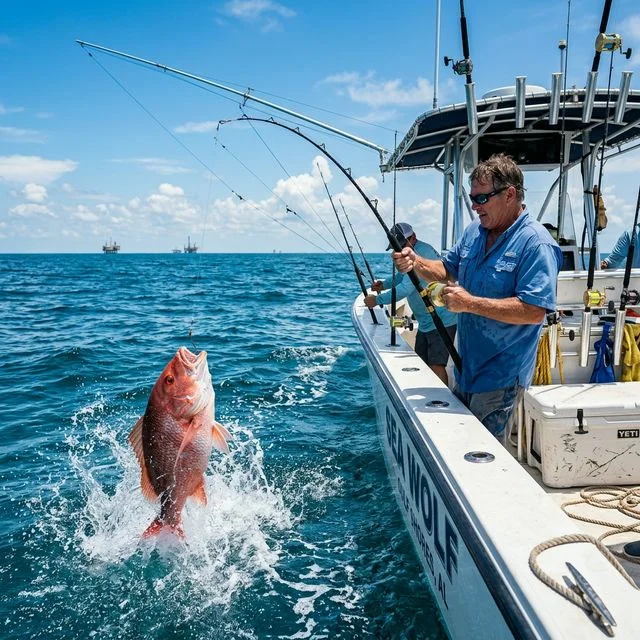
Red Snapper Season
Red snapper season is set annually by ADCNR and varies based on quota allocation:
- Private anglers and state-licensed charter vessels: Season opens in late May/early June; daily access typically transitions to weekend-only fishing once initial allocation is consumed
- Federally permitted for-hire vessels: Separate, typically longer season (100+ days)
- 2026 season: Announced annually by ADCNR, typically in spring — check outdooralabama.com for current dates
Gulf Reef Fish Endorsement Reminder
Every angler 16+ targeting any Gulf reef species must have the $10 annual Gulf Reef Fish Endorsement — including charter boat passengers. This applies regardless of your license type, age exemption, or veteran status. No exceptions. See the saltwater guide for the full species list and details.
License Requirements Quick Reference
| Category | License Needed? | Details |
|---|---|---|
| Alabama residents 16–64 | ✅ Yes | Freshwater and/or saltwater |
| Alabama residents 65+ | ❌ Exempt | Senior guide |
| Alabama residents under 16 | ❌ Exempt | Age requirements |
| Non-residents 16+ | ✅ Yes | Non-resident guide |
| Non-residents under 16 | ❌ Exempt | No license needed |
| Residents on military leave | ❌ Exempt | Veteran guide |
| Bank fishing in home county | ❌ Exempt | Rod-and-reel or pole, freshwater only |
Bank fishing exemption: Alabama residents may fish from the bank with a rod-and-reel or pole in public freshwater in their county of residence without a license. This is one of the least-known exemptions in Alabama law.
Where to Get the Full Regulations
The Alabama Hunting and Fishing Digest (published annually) contains the complete official regulations, including all reservoir-specific rules, special management areas, and seasonal updates.
- Online: outdooralabama.com
- eRegulations: eregulations.com/alabama/fishing — searchable digital version
- In print: Free at license retailers, bait shops, tackle stores, and ADCNR offices statewide
- Mobile: The Outdoor Alabama app includes current regulations with GPS-based water body identification
Alabama’s regulations are detailed because the state manages an extraordinary range of fisheries — from cold-water trout in the Sipsey Fork to subtropical Gulf reefs. The five minutes you spend checking the specific rules for your destination water body will keep you fishing with confidence instead of anxiety.